Q66 · 9706/41/M/J/23 Q1
Worked solution from the Cost and management accounting (A Level) Theory (Paper 4) booklet, Part 4 of 4.

Worked solution
(a)(i)
NPV = total of discounted net cash flows − initial payment. Proceeds each year = $500 000 × progress of the dig; government gets 10% of proceeds.
| Year | Proceeds $ | Government 10% $ | Costs $ | Net cash flow $ |
|---|---|---|---|---|
| 0 | (100 000) [1] | |||
| 1 | 225 000 | (22 500) | (116 500) | 86 000 [1] |
| 2 | 125 000 | (12 500) | (98 500) | 14 000 [2] |
| 3 | 100 000 | (10 000) | (67 000) | 23 000 [1] |
| 4 | 50 000 | (5 000) | (23 000) | 22 000 [2] |
Proceeds: Year 1 = 45% × $500 000 = $225 000; Year 2 = 25% = $125 000; Year 3 = 20% = $100 000; Year 4 = 10% = $50 000.
| Year | Net cash flow $ | Discount factor | Discounted cash flow $ |
|---|---|---|---|
| 0 | (100 000) | 1 | (100 000) |
| 1 | 86 000 | 0.909 | 78 174 |
| 2 | 14 000 | 0.826 | 11 564 |
| 3 | 23 000 | 0.751 | 17 273 |
| 4 | 22 000 | 0.683 | 15 026 |
| Total of years 1 to 4 | 122 037 [1] |
NPV = $122 037 − $100 000 = $22 037 [1]
(a)(ii)
Payback period = time taken for cumulative net cash flow to repay the initial payment.
| Year | Net cash flow $ | Cumulative $ |
|---|---|---|
| 0 | (100 000) | (100 000) [1] |
| 1 | 86 000 | (14 000) |
| 2 | 14 000 | 0 [1] |
Payback period = 2 years [1]
(a)(iii)
ARR = average annual profit ÷ average investment × 100
Total profit = $86 000 + $14 000 + $23 000 + $22 000 − $100 000 = $45 000 [1]
Average profit = $45 000 ÷ 4 = $11 250 [1]
Average investment = $100 000 ÷ 2 = $50 000 [1]
ARR = $11 250 ÷ $50 000 × 100 = 22.5% [1]
(b)
Advise: give a decision with comments (up to 6 marks for comments, 1 for a decision supported with a comment).
Write a decision (for example: go ahead) supported by a comment. [1]
The NPV is positive, so the dig would be financially beneficial. [1]
The payback period is short, which indicates lower risk. [1]
The ARR is well above his cost of capital (10%). [1]
NPV is considered the most reliable method. [1]
Against: despite the short payback this is a very risky venture; Barry cannot be certain of the quantity and condition of the items, [1]
nor of the proceeds, as museums may have limited budgets and a unique item's value is hard to judge; there may be extra costs, such as restoring the field. Max 6 for comments. [1]
(c)
Write any two:
It ignores the time value of money. [1]
It ignores the timing of cash flows. [1]
Official mark scheme

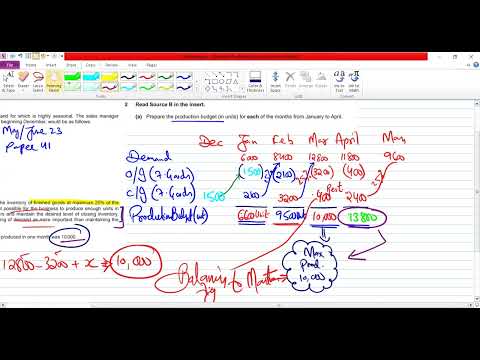 ▶ Whole paper
Video solution of the whole paper · by Sir Faizan Farooq Tola. Tap the picture to open it on YouTube.
Solutions follow the official Cambridge mark schemes; marks are shown in grey. Videos are from other YouTube channels. Paper codes read component / series / year: M/J = May/June, O/N = October/November. Past-paper questions © UCLES, reproduced for classroom practice.