Q17 · 0455/23/O/N/23 Q2
Worked solution from the International trade and globalisation Theory (Paper 2) booklet, Part 2 of 4.

Worked solution
(a)
Identify means: give the points only. Write any two of these:
Unemployment [1]
Sickness or poor health (or old age, war, famine, natural disasters, low education, lack of government benefits) [1]
(b)
Explain two causes. For each: name the cause, then say how it raises development.
Cause 1: improvements in education [1]
They improve productive capacity, which can raise wages or reduce unemployment. [1]
Cause 2: improvements in healthcare [1]
They can increase life expectancy. [1]
Other causes that score: better technology, more savings, more investment, more FDI, more workers in the tertiary sector, higher incomes, more government spending on infrastructure, more international trade, discovery of new resources.
(c)
Analyse means: give each step of the chain of reasoning. First draw the diagram.
Draw a PPC diagram: label the vertical axis with one output (for example capital goods) and the horizontal axis with a different output (for example consumer goods). Do not use just A and B. [1]
Draw the initial PPC as a curve sloping down and touching both axes. [1]
Draw the new PPC as a curve sloping down and touching both axes, inside the first one. [1]
Show the shift inwards with an arrow or letters. [1]
Write: a serious storm destroys infrastructure (bridges, factories, roads, electricity lines) and reduces the factors of production available, [1]
so it reduces the ability to produce goods and services: the productive capacity of the economy falls. [1]
(d)
Discuss means: explain why it might, explain why it might not, then decide. Develop both sides.
Why it might: tariffs raise the price of imports, so people may switch to buying home-produced goods, [1]
so net exports may increase, which raises total demand, [1]
and the higher demand encourages the country's firms to produce more goods and services. [1]
The government could also use the tariff revenue to subsidise home-produced goods. [1]
Why it might not: even with tariffs, imports may still be cheaper than home-produced goods, [1]
or there may be no home-produced substitutes, so people still buy imports. [1]
If the tariffs are on raw materials and capital goods, firms' costs of production rise and demand may fall, [1]
and other countries may retaliate, raising the price of this country's exports and reducing demand for them. [1]
Official mark scheme

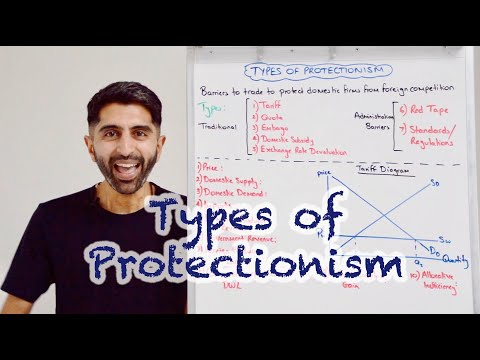 ▶ Topic lesson
A lesson on this topic · by EconplusDal. Tap the picture to open it on YouTube.
Solutions follow the official Cambridge mark schemes; marks are shown in grey. Videos are from other YouTube channels. Paper codes read component / series / year: M/J = May/June, O/N = October/November. Past-paper questions © UCLES, reproduced for classroom practice.