Q53 · 9618/33/O/N/25 Q2
Worked solution from the Data Representation Paper 3 Advanced Theory booklet, Part 3 of 3.

Worked solution
(a)
The system has 16 bits in total, so fewer mantissa bits means more exponent bits. Write:
The precision (accuracy) of the numbers stored falls, because the mantissa has fewer bits [1]
The exponent gets more bits (6 bits) [1]
So the range of numbers that can be stored increases [1]
(b)
Describe one situation, then say what happens. For example:
A calculation such as multiplying two very large numbers takes place [1]
The result is too big to store, outside the range the system can hold [1]
The most significant bits of the mantissa or exponent are lost, which is the overflow, so the stored value is wrong [1]
Official mark scheme

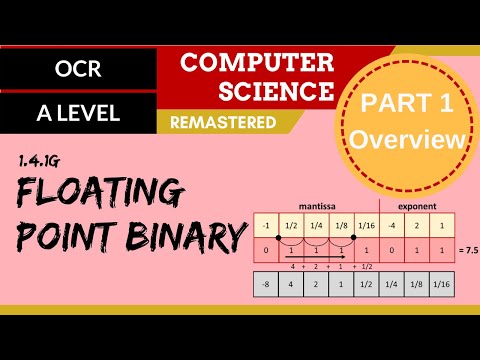 ▶ Topic lesson
A lesson on this topic · by Craig'n'Dave. Tap the picture to open it on YouTube.
Solutions follow the official Cambridge mark schemes; marks are shown in grey. Videos are from other YouTube channels. Paper codes read component / series / year: M/J = May/June, O/N = October/November. Past-paper questions © UCLES, reproduced for classroom practice.