Q14 · 9701/41/O/N/23 Q1
Worked solution from the Reaction kinetics Theory (Paper 4) booklet, Part 1 of 2.

Worked solution
(a)(i)
The rate equation has one F2 and one ClO2, so the slow first step uses one of each. The two steps must add up to the overall equation.
Step 1: F2 + ClO2 → FClO2 + F [1]
Step 2: ClO2 + F → FClO2 [1]
(Check: adding gives F2 + 2ClO2 → 2FClO2. An alternative is F2 + ClO2 → F2ClO2, then F2ClO2 + ClO2 → 2FClO2.)
(a)(ii)
Write: step 1 is rate-determining, because it contains one molecule of F2 and one of ClO2, the same as the orders in the rate equation. [1]
(b)(i)
Write rate = k[F2][ClO2] (or 1.22[F2][ClO2]) and the overall order is 2. [1]
(b)(ii)
rate = 1.22 × 2.00 × 10–3 × 2.00 × 10–3
Write rate = 4.88 × 10⁻⁶ mol dm–3 s–1. [1]
(c)(i)
For a first-order reaction, k = 0.693 ÷ t1/2.
k1 = 0.693 ÷ 4.00 = 0.173 (3 s.f.). Write 0.173. [1]
Units: write s–1. [1]
(c)(ii)
Each half-life (4 s) halves the concentration.
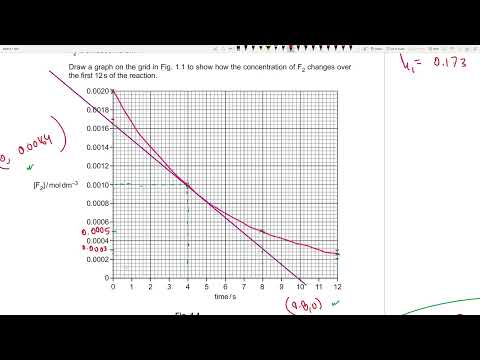
Plot (0, 0.00200), (4, 0.00100), (8, 0.00050), (12, 0.00025) and join them with a smooth curve that falls and flattens. All must be correct. [1]
(c)(iii)
Draw a tangent to your curve at [F2] = 0.00100 and find its gradient (rise ÷ run, ignoring the sign).
Write rate = about 1.5 to 2.0 × 10⁻⁴ mol dm–3 s–1 (the exact value is 0.173 × 0.00100 = 1.73 × 10⁻⁴). [1]
Official mark scheme

 ▶ Whole paper
Video solution of the whole paper · by CAIE PAPERS SOLVED. Tap the picture to open it on YouTube.
Solutions follow the official Cambridge mark schemes; marks are shown in grey. Videos are from other YouTube channels. Paper codes read component / series / year: M/J = May/June, O/N = October/November. Past-paper questions © UCLES, reproduced for classroom practice.