Q10 · 5070/21/O/N/23 Q3
Worked solution from the Chemical reactions Theory (Paper 2) booklet, Part 1 of 3.

Worked solution
(a)
Zinc is a solid, the acid is in water, and hydrogen is a gas.
Write Zn(s) + 2HCl(aq) → ZnCl2(aq) + H2(g).
All three state symbols correct earns the 2 marks (one or two correct earns 1). [2]
(b)(i)
On the graph, go up to 39 cm3 on the vertical axis, across to the curve, then down to the time axis.
Write 150 s. [1]
(b)(ii)
A higher concentration means a faster rate, but the acid is in excess so the same amount of zinc reacts and the same volume of gas is made.
Draw a curve from (0, 0) with a steeper start (initial gradient) than the original line. [1]
It then levels off as a horizontal line at 42 cm3, the same final volume as the original. [1]
(c)
Prediction: the rate of reaction increases.
The particles move faster (they have more kinetic energy). [1]
So there are more successful collisions (more particles with energy equal to or above the activation energy). [1]
(d)
Lower pressure means the gas particles are less squashed.
Write: the particles move further apart. [1]
Official mark scheme

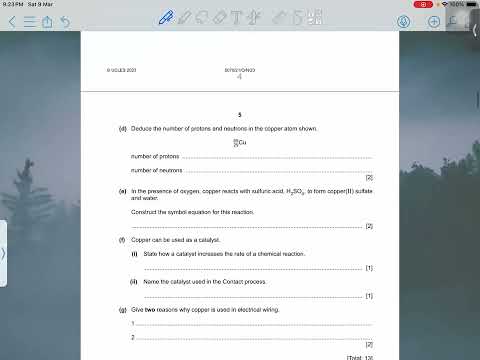 ▶ Whole paper
Video solution of the whole paper · by Dr Sajjad Haider. Tap the picture to open it on YouTube.
Solutions follow the official Cambridge mark schemes; marks are shown in grey. Videos are from other YouTube channels. Paper codes read component / series / year: M/J = May/June, O/N = October/November. Past-paper questions © UCLES, reproduced for classroom practice.