Q8 · 0610/42/M/J/21 Q1
Worked solution from the Coordination and response Theory (Paper 4) booklet, Part 2 of 5.

Worked solution
(a)
Think about which parts of the nervous system are inside the body's centre and which reach out to the body.
Write: the brain and spinal cord form the central nervous system and the nerves form the peripheral nervous system. [1]
(b)(i)
Neurone A carries impulses from the brain towards the eye, so it makes the muscle respond.
Write: motor (neurone). [1]
(b)(ii)
Match each function to a part and find its letter on Fig. 1.1. One mark per row.
Suspensory ligament: function is to control the shape (thickness) of the lens for focusing, or to attach the lens to the ciliary muscles; letter is G. [1]
Function 'contracts in response to a bright light': circular muscles (iris), letter E. [1]
Cornea: function is to refract (bend) light, letter D. [1]
Function 'high density of cones for colour vision': fovea, letter J. [1]
(c)(i)
Focusing on a near object makes the ciliary muscles work.
Write: ciliary muscles contract (or conduction of nerve impulses). [1]
(c)(ii)
Write: haemoglobin. [1]
(c)(iii)
Oxygen moves out of the capillary into eye cells by diffusion. [1]
It moves down a concentration gradient, from high concentration in the blood to low in the cells. Any one other point also scores: it is a passive process, or it goes through the thin capillary wall. [1]
(d)(i)
Give two mechanical barriers other than eyelashes and eyelids. Any two of these:
Hairs in the nose. [1]
Skin. [1]
(d)(ii)
Write: phagocytes. [1]
(d)(iii)
Active immunity needs the body to make its own antibodies. Any three of these:
Different pathogens have antigens with different (unique) shapes, and pathogens have antigens. [1]
Lymphocytes make specific antibodies. [1]
Antibodies have a shape complementary (specific) to the antigen, so they mark or destroy the pathogen. [1]
(Also credited: memory cells are made, so a faster response next time.)
(e)
Insects and crustaceans both have jointed legs and an exoskeleton.
Write: arthropods. [1]
Official mark scheme

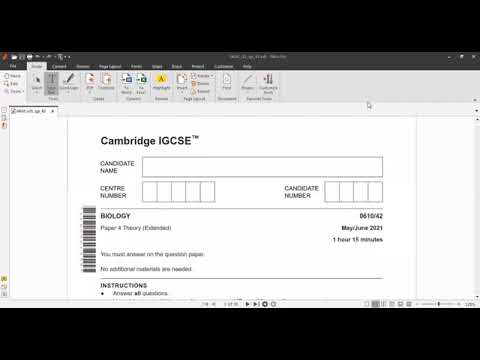 ▶ Whole paper
Video solution of the whole paper · by MaryAnneSchool. Tap the picture to open it on YouTube.
Solutions follow the official Cambridge mark schemes; marks are shown in grey. Videos are from other YouTube channels. Paper codes read component / series / year: M/J = May/June, O/N = October/November. Past-paper questions © UCLES, reproduced for classroom practice.