Q5 · 9701/42/M/J/23 Q7
Worked solution from the Hydroxy compounds Theory (Paper 4) booklet, Part 1 of 1.

Worked solution
(a)
Think about what the OH group does to the ring.
A p-orbital (lone pair) on oxygen overlaps and is delocalised into the ring. [1]
This gives greater π electron density, so the ring (positions 2, 4, 6) is more electron-rich. [1]
The ring polarises electrophiles (Br2) more easily. [1]
(b)
In I–Br the more electronegative atom is Br, so it is δ− and I is δ+. The electrophile is the δ+ end.
Write iodobenzene, because Br is more electronegative than I, so I is the electrophilic end. [1]
(c)(i)
Phenol is an acid and reacts with sodium.
Write: C6H5OH + Na → C6H5O−Na+ + ½H2 [1]
(c)(ii)
Excess Br2(aq) replaces H at positions 2, 4 and 6.
R is 2,4,6-tribromophenol. [1]
(c)(iii)
Reaction 1 gives 4-nitrophenol. Reaction 2 gives an azo compound.
Reaction 1: dilute (aqueous) HNO3. [1]
Reaction 2: alkaline (NaOH) and a benzenediazonium ion, C6H5N2+(Cl−). [1]
Official mark scheme

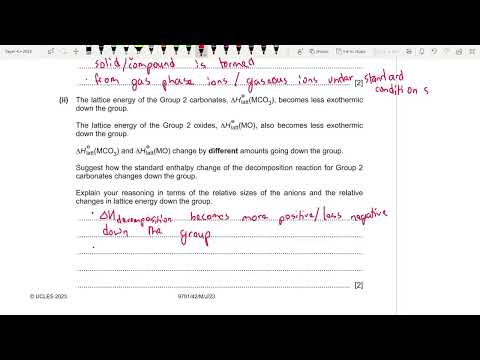 ▶ Whole paper
Video solution of the whole paper · by CAIE PAPERS SOLVED. Tap the picture to open it on YouTube.
Solutions follow the official Cambridge mark schemes; marks are shown in grey. Videos are from other YouTube channels. Paper codes read component / series / year: M/J = May/June, O/N = October/November. Past-paper questions © UCLES, reproduced for classroom practice.