Q68 · 9706/43/O/N/23 Q2
Worked solution from the Cost and management accounting (A Level) Theory (Paper 4) booklet, Part 4 of 4.

Worked solution
(a)(i)
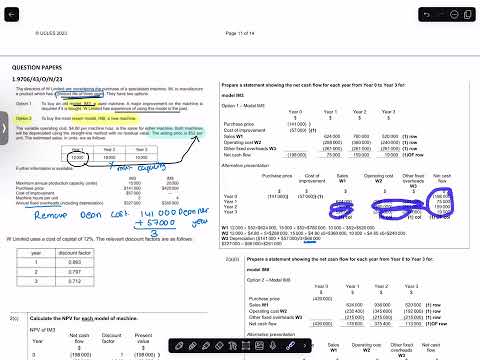
Net cash flow = sales − operating cost − other fixed overheads (depreciation is not a cash flow, so it is taken out of the fixed overheads).
Workings:
W1 Sales = units × $52: 12 000 → $624 000; 15 000 → $780 000 (capacity is 15 000, so Year 2 is limited); 10 000 → $520 000.
W2 Operating cost = units × $4.80 × 5 machine hours: $288 000; $360 000; $240 000.
W3 Depreciation = ($141 000 + $57 000) ÷ 3 = $66 000; other fixed overheads = $327 000 − $66 000 = $261 000.
Option 1 – Model IM3
| Details | Year 0 $ | Year 1 $ | Year 2 $ | Year 3 $ |
|---|---|---|---|---|
| Purchase price | (141 000) | |||
| Cost of improvement | (57 000) | [1] | ||
| Sales W1 | 624 000 | 780 000 | 520 000 [1] | |
| Operating cost W2 | (288 000) | (360 000) | (240 000) [1] | |
| Other fixed overheads W3 | (261 000) | (261 000) | (261 000) [1] | |
| Net cash flow | (198 000) | 75 000 | 159 000 | 19 000 [1] |
(a)(ii)
Workings:
W1 Sales = units × $52: 12 000 → $624 000; 18 000 → $936 000; 10 000 → $520 000 (all within the capacity of 20 000).
W2 Operating cost = units × $4.80 × 4 machine hours: $230 400; $345 600; $192 000.
W3 Depreciation = $420 000 ÷ 3 = $140 000; other fixed overheads = $355 000 − $140 000 = $215 000.
Option 2 – Model IM8
| Details | Year 0 $ | Year 1 $ | Year 2 $ | Year 3 $ |
|---|---|---|---|---|
| Purchase price | (420 000) | |||
| Sales W1 | 624 000 | 936 000 | 520 000 [1] | |
| Operating cost W2 | (230 400) | (345 600) | (192 000) [1] | |
| Other fixed overheads W3 | (215 000) | (215 000) | (215 000) [1] | |
| Net cash flow | (420 000) | 178 600 | 375 400 | 113 000 [1] |
(b)
Write any two advantages of NPV (one mark each):
It uses cash flows, which are more objective than profits. [1]
It takes account of the time value of money. [1]
Another accepted advantage: it takes account of all the cash flows of the project.
(c)
NPV = sum of (net cash flow × discount factor) for years 0 to 3. Year 0 has a factor of 1.
NPV of IM3
| Year | Net cash flow $ | Discount factor | Present value $ |
|---|---|---|---|
| 0 | (198 000) | 1 | (198 000) |
| 1 | 75 000 | 0.893 | 66 975 |
| 2 | 159 000 | 0.797 | 126 723 |
| 3 | 19 000 | 0.712 | 13 528 [1] |
| NPV | 9 226 [1] |
NPV of IM8
| Year | Net cash flow $ | Discount factor | Present value $ |
|---|---|---|---|
| 0 | (420 000) | 1 | (420 000) |
| 1 | 178 600 | 0.893 | 159 490 |
| 2 | 375 400 | 0.797 | 299 194 |
| 3 | 113 000 | 0.712 | 80 456 [1] |
| NPV | 119 140 [1] |
(d)
Advise means: give the points and then a decision with a comment. Any six comments, then the decision.
IM8 has a higher positive NPV than IM3 ($119 140 against $9 226). [1]
IM8 is more efficient (fewer machine hours), giving lower operating costs. [1]
IM8 has a higher initial outlay. [1]
IM3 has been used before so there is no need for training, but IM8 may need training of workers. [1]
IM8 is a new model, so the quality of products may be better. [1]
IM8 has more production capacity to meet urgent sales orders. [1]
Other valid points are accepted, for example the opportunity cost and the method of financing IM8.
Decision: choose IM8, because its NPV is much higher. [1]
(e)
Extra units in Year 2 = 18 000 − 15 000 = 3 000. Contribution per unit = $52 − ($4.80 × 5) = $28.
NPV of additional revenue = 3 000 × $28 × 0.797 = $66 948 [1]
NPV of the extra improvement cost = $5 000 × 0.893 = ($4 465) [1]
Increase in NPV = $66 948 − $4 465 = $62 483 [1]
Official mark scheme

 ▶ Whole paper
Video solution of the whole paper · by IGCSE / AS LEVEL / A LEVEL MATHS AND ACCOUNTS. Tap the picture to open it on YouTube.
Solutions follow the official Cambridge mark schemes; marks are shown in grey. Videos are from other YouTube channels. Paper codes read component / series / year: M/J = May/June, O/N = October/November. Past-paper questions © UCLES, reproduced for classroom practice.