Q42 · 9708/21/O/N/25 Q1
Worked solution from the Government microeconomic intervention Theory (Paper 2) booklet, Part 2 of 3.

Worked solution
(a)
A mixed economy allocates resources through both a private sector and a public (state) sector. [1]
Evidence: the article mentions private sector rivals and private firms needing permits (private sector), and state-owned companies being given priority and 'the balance of the mixed economy' (public sector). So Mexico is a mixed economy. [1]
(b)
Write: opportunity cost is the value of the next best alternative given up when a decision is made. [1]
Apply it: because of the new policy, multinational companies that might have located in Mexico may go elsewhere, OR Mexico failed to move to renewable energy, although economists reckon it could have produced almost half its electricity from renewables long before 2050. [1]
(c)
Consider means: give the possible advantages and disadvantages for consumers, then judge how far it is an advantage.
Advantage: state-owned companies may have more financial resources than the private sector, which could mean lower prices and a more efficient supply. They may also act in the national interest. [1]
Another advantage: state-owned companies may be seen as drivers of growth, possibly leading to higher living standards. [1]
Disadvantage: operating costs of state-owned producers are significantly higher than private rivals, so consumers could face higher prices; or their old, inefficient plants are expensive to maintain, so supply is less efficient; or there will be less investment in renewable energy. [1]
Advantages and disadvantages together can earn at most 3 marks, so two advantages and one disadvantage, or one advantage and two disadvantages, give full marks for the points.
Evaluation: the advantage to consumers is likely to be limited, because the article says costs will be passed on to consumers (give any valid judgement). [1]
(d)
Assess means: explain the possible advantages and disadvantages of a subsidy, then decide which are larger.
Diagram: draw price up and quantity along, with demand D and supply S for electricity, correctly labelled, crossing at P, Q. A subsidy lowers costs, so draw S1 to the right of S with a new equilibrium P1, Q1. [1]
Advantage: the subsidy gives a lower price (P1 below P) [1]
and a higher quantity (Q1 above Q), so more households and firms can use electricity. [1]
Disadvantage: the subsidy has to be financed by the government, from taxes or by borrowing. [1]
Another disadvantage you can use: it could lead to inefficiencies (producers keep high costs), and there is an opportunity cost because the money could be used on other things. The points can earn at most 4 marks in total, including the diagram.
Evaluation: weigh up the advantages and disadvantages, for example that a lower price helps consumers but the cost to the government rises as the subsidy grows. [1]
Conclusion: the advantages are likely to outweigh the disadvantages only if the subsidy is affordable and temporary; otherwise the costs outweigh them (accept any reasoned conclusion). [1]
(e)
Assess means: explain the benefits and limitations of keeping oil for electricity, then weigh them.
Benefit: Mexico moves towards energy self-sufficiency, so it relies less on imports of natural gas. [1]
The country can produce its own electricity and is less exposed to global energy price and supply shocks. [1]
Limitation: it is unclear whether Mexico has the capacity to produce enough electricity for its 130 million people. [1]
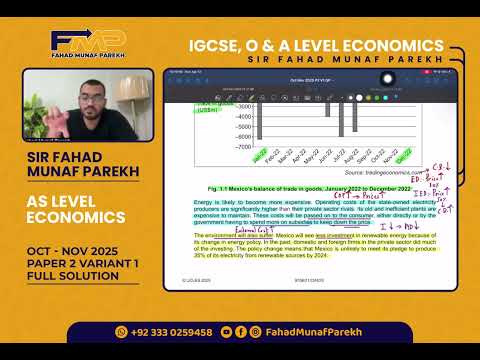
Impact on the balance of trade: Mexico has traditionally exported crude oil. Fig. 1.1 shows a deficit in nine of the twelve months of 2022 (for example about US$6000m below zero in January and in July), and keeping oil at home means less export income, so the deficit may get worse. [1]
Evaluation: weigh the benefit of self-sufficiency against the risk of weak capacity and a worse trade balance. [1]
Conclusion: the policy is beneficial only if Mexico can produce enough electricity and the trade effect is manageable (accept any reasoned conclusion). [1]
Official mark scheme

 ▶ Whole paper
Video solution of the whole paper · by Fahad Munaf Parekh. Tap the picture to open it on YouTube.
Solutions follow the official Cambridge mark schemes; marks are shown in grey. Videos are from other YouTube channels. Paper codes read component / series / year: M/J = May/June, O/N = October/November. Past-paper questions © UCLES, reproduced for classroom practice.