Q42 · 9708/22/O/N/22 Q3
Worked solution from the Government macroeconomic intervention Theory (Paper 2) booklet, Part 4 of 4.

Worked solution
(a)
A PPC is a curve for two named goods that touches both axes and shows the best the economy can make.
Write: a PPC shows the maximum output an economy can achieve [1]
given its current resources and technology. [1]
Scarcity means resources are limited compared with wants. [1]
It is shown by the PPC being a frontier: the economy cannot produce at any point outside the curve. [1]
Choice means deciding between products when resources are limited. [1]
It is shown by a movement along the PPC, producing more of one good and less of the other. [1]
Opportunity cost is the next best alternative given up. [1]
It is shown when moving along the curve: the output of one good that is sacrificed to produce more of the other. [1]
(b)
Discuss means: difficulties of supply-side policies, how to overcome them, then a judgement. Name more than one policy and more than one difficulty for full marks.
Policy and difficulty: for example more education and training can raise the economy's productive capacity, but it is costly (it needs a lot of government spending). [1]
Another difficulty: supply side policies can take a long time to have an effect. [1]
Second policy: investment in infrastructure also raises productive capacity. [1]
Its difficulty: it is also costly and slow to complete. [1]
Overcome: a shortage of funds can be overcome through inward investment from abroad (in developing economies, for example). [1]
The time lag can be reduced by starting early and choosing policies that work faster. [1]
Methods can be combined, for example paying for a policy with inward investment while starting with the quickest policies. [1]
A method may bring its own problem, so it is not always certain. [1]
Evaluation: judge the likely success, taking the difficulties into account (cost, time, shortage of funds). [1]
Consider the type of economy: success depends on whether the funds and time are available. [1]
Consider how fully the difficulties can really be overcome. [1]
Conclusion: write a reasoned view, for example that the difficulties can mostly be overcome but success is slow and not guaranteed. [1]
Official mark scheme

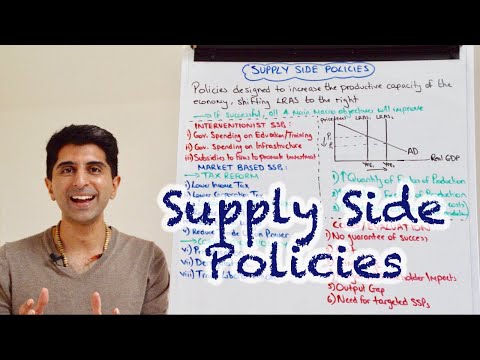 ▶ Topic lesson
A lesson on this topic · by EconplusDal. Tap the picture to open it on YouTube.
Solutions follow the official Cambridge mark schemes; marks are shown in grey. Videos are from other YouTube channels. Paper codes read component / series / year: M/J = May/June, O/N = October/November. Past-paper questions © UCLES, reproduced for classroom practice.