Q62 · 0620/23/O/N/25 Q16
Worked solution from the Chemical energetics MCQ booklet.

Worked solution
We check each statement.
A says a vigorous reaction at room temperature has a high activation energy. It is the opposite: a vigorous reaction has a low activation energy. Wrong.
B says bond making is endothermic. Making bonds gives out energy, so it is exothermic. Wrong.
C says that in an exothermic reaction, the energy needed to break bonds is less than the energy released making bonds. This is correct.
D says a positive enthalpy change transfers energy to the surroundings. A positive ∆H means energy is taken in from the surroundings. Wrong.
So the answer is C.
 ▶ Whole paper
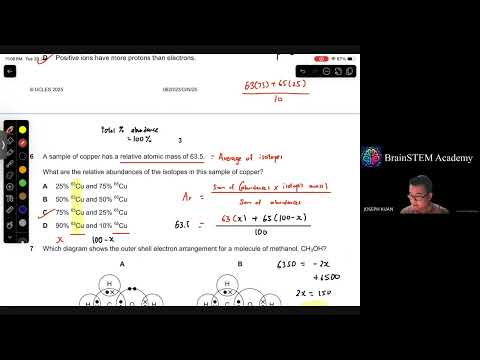
Video solution of the whole paper · by Teacher Joseph Kuan - IGCSE Chemistry Online Tutor. Tap the picture to open it on YouTube.
Solutions follow the official Cambridge mark schemes. Videos are from other YouTube channels. Paper codes read component / series / year: M/J = May/June, O/N = October/November. Past-paper questions © UCLES, reproduced for classroom practice.