Q3 · 0455/22/O/N/21 Q5
Worked solution from the Economic development Theory (Paper 2) booklet, Part 1 of 4.

Worked solution
(a)
Identify means: just name two. Write any two of these:
Progressive taxation (higher taxes on high incomes, lower taxes on low incomes) [1]
State benefits (or spending on state education or training, spending on state healthcare, equal pay legislation, a minimum wage) [1]
(b)
Write two advantages, each with an explanation. Any two of these:
Consumer sovereignty [1]
because consumers decide what goods and services are produced. [1]
Low prices [1]
due to competition. [1]
Other advantages that earn the marks: high quality (due to innovation), consumer choice (a variety of products), greater efficiency (due to the profit motive), and automatic adjustment to changes in demand and supply through the price mechanism.
(c)
Analyse means: give each step of the chain of reasoning.
Incomes may fall, [1]
which lowers living standards and reduces access to basic necessities. [1]
There may be a reduction in healthcare, for example limited access to medication, [1]
or a rise in poor nutrition (malnutrition), with people eating low-quality food or not having enough food. [1]
There may be more pollution, which makes people more open to disease, [1]
or new diseases or pandemics, wars, or climate change causing natural disasters. [1]
Other chains that earn marks: less education leads to unhealthy lifestyles (more smoking, junk food, less exercise); more people in dangerous jobs with poor conditions cause more sickness and accidents.
(d)
Discuss means: explain why they might, explain why they might not, then decide.
Why they might: they may increase total (aggregate) supply, which reduces cost-push inflation, [1]
education and training raise labour productivity, which lowers labour costs, [1]
and a cut in direct taxes gives more incentive to work and innovate, labour market reforms may reduce the rise in wages, and subsidies lower costs. [1]
Why they might not: privatisation does not always increase competition, so it does not always lower prices, [1]
education and training can be expensive, may be in areas not in demand, and have a time lag, [1]
a cut in income tax may increase total demand as well as supply, resources may be limited, and inflation may be caused by rising raw material prices (for example oil) with no home substitute. [1]
Conclusion: write that it depends on what causes the inflation and how quickly the policies work. Supply-side policies help most against cost-push inflation in the longer run. [2]
Official mark scheme

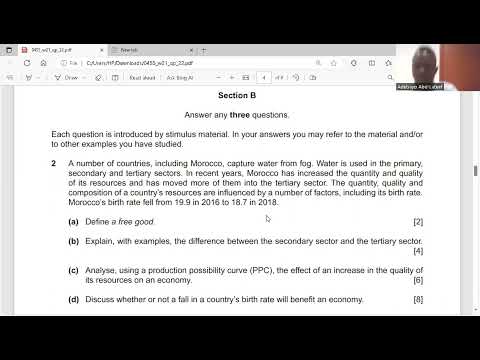 ▶ Whole paper
Video solution of the whole paper · by Adebayo Business 👨💼 Tutor (ABT). Tap the picture to open it on YouTube.
Solutions follow the official Cambridge mark schemes; marks are shown in grey. Videos are from other YouTube channels. Paper codes read component / series / year: M/J = May/June, O/N = October/November. Past-paper questions © UCLES, reproduced for classroom practice.