Q2 · 0610/43/O/N/20 Q4
Worked solution from the Biotechnology and genetic modification Theory (Paper 4) booklet, Part 1 of 2.

Worked solution
(a)
Change the length of a square side from μm to mm: 200 μm = 200 ÷ 1000 = 0.2 mm. [1]
Volume of one square = 0.2 × 0.2 × 0.1 = 0.004 mm3 (depth 100 μm = 0.1 mm). [1]
Cells per mm3 = 52 ÷ 0.004 = 13 000 cells per mm3. (Same answer from 52 × 25 = 1300 cells in 0.1 mm3, then × 10.) [1]
(b)(i)
The lag phase is the slow start when the yeast cells are just getting used to the conditions. On Fig. 4.3 it is the flat, low part of the line.
Write: put an X on the line between day 0 and day 1. [1]
(b)(ii)
After day 3 the line keeps rising, but more slowly, and then levels off as the sugar runs low.
Draw the line continuing from day 3, rising more slowly and then levelling out. [1]
At the end (as the sugar is used up, around days 9 and 10) draw the line falling, to show the population decreasing. [1]
(b)(iii)
Read Fig. 4.2: sugar falls from 19 g per dm3 at day 0 to 16 at day 6 (slowly), to 7.5 at day 9 (quickly), and stays at 7.5 from day 9 to day 10. Write any five of these:
From day 0 to 6 the sugar concentration decreases slowly (19 to 16 g per dm3) because there are few yeast cells (lag phase). [1]
The yeast population affects how fast the sugar goes down. [1]
The yeast use sugar in respiration, and this releases energy. [1]
Between day 6 and day 9 the sugar decreases faster (16 to 7.5 g per dm3) because there are many more yeast cells. [1]
From day 9 there is no change (it stops decreasing at 7.5 g per dm3) because the yeast have died (death phase), or the ethanol or a change in pH killed them, so some sugar is left over. [1]
(c)
Think about what yeast produces when it respires.
Write: yeast respiration makes carbon dioxide. [1]
Write: if the gas cannot escape, the gas pressure would increase (and the fermenter could burst). [1]
Official mark scheme

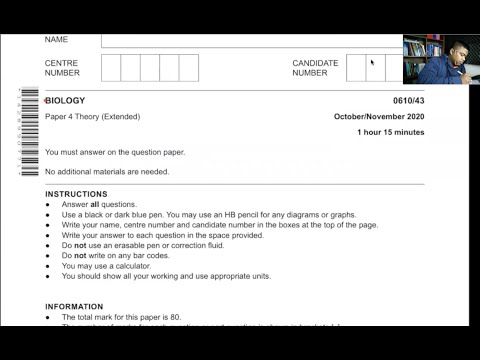 ▶ Starts at Q4 (30:42)
Starts at Q4 (30:42) · by Chemistry & Biology @ Belal Sir. Tap the picture to open it on YouTube.
Solutions follow the official Cambridge mark schemes; marks are shown in grey. Videos are from other YouTube channels. Paper codes read component / series / year: M/J = May/June, O/N = October/November. Past-paper questions © UCLES, reproduced for classroom practice.