Q2 · 9701/22/O/N/23 Q1
Worked solution from the The Periodic Table: chemical periodicity Theory (Paper 2) booklet, Part 1 of 3.

Worked solution
(a)(i)
Across a period the nuclear charge goes up but the shielding stays the same.
Write: atomic radius decreases from Si to S. [1]
(a)(ii)
Compare the structure of each element and what you must break when it melts.
Silicon is giant covalent and sulfur is simple molecular (with weak intermolecular forces). [1]
Melting Si means breaking covalent bonds. Melting S means breaking only intermolecular forces. [1]
Covalent bonds are strong, so more energy is needed than for the weak intermolecular forces. [1]
(b)(i)
Si is 1s22s22p63s23p2, P is ...3s23p3, S is ...3s23p4.
s electrons: write 6, 6, 6 for Si, P, S. [1]
p electrons: write 8, 9, 10 for Si, P, S. [1]
(b)(ii)
Ionisation energy removes one electron from one mole of gaseous atoms.
Si(g) → Si+(g) + e– [1]
(b)(iii)
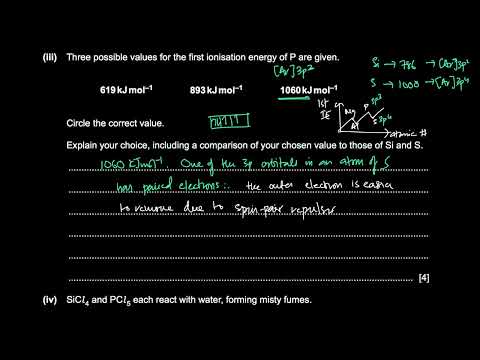
P is after Si, so its value should be higher than 786. S is lower than P because of electron pairing, so P is higher than 1000.
Circle 1060. [1]
P has a greater nuclear charge than Si, so a greater attraction between nucleus and outer electrons. [1]
So its ionisation energy is higher than Si (786). [1]
S has two electrons in one 3p orbital, so there is spin-pair repulsion, making S lower than P. [1]
(b)(iv)
Both chlorides are hydrolysed by water.
Write hydrogen chloride, HCl. [1]
(b)(v)
S has two bonding pairs and two lone pairs.
Write non-linear (bent). [1]
Official mark scheme

 ▶ Whole paper
Video solution of the whole paper · by Abdullah Ghelli. Tap the picture to open it on YouTube.
Solutions follow the official Cambridge mark schemes; marks are shown in grey. Videos are from other YouTube channels. Paper codes read component / series / year: M/J = May/June, O/N = October/November. Past-paper questions © UCLES, reproduced for classroom practice.