Q22 · 9701/42/O/N/25 Q7
Worked solution from the Analytical techniques Theory (Paper 4) booklet, Part 3 of 3.

Worked solution
(a)
A carbon with four different groups is chiral. Only Q, CH3CH2CH(CH3)CHO, has one.
Draw the central C with C2H5, CH3, CHO and H: one 3D diagram with CH3 on a wedge and H dashed, and the other with them swapped (mirror images). Show both correctly. [2]
(b)(i)
The test is positive for CH3CO– groups.
The two are T (CH3CH2CH2COCH3) and V ((CH3)2CHCOCH3). [1]
(b)(ii)
Observation: yellow solid (precipitate). Products: CHI3 and the carboxylic acid, for example CH3CH2CH2COOH (from T) or (CH3)2CHCOOH (from V). Any two of the three points scores 1, all three scores 2. [2]
(c)(i)
(CH3)3CCHO has a 9H singlet and a 1H singlet.
The compound is S. [1]
(c)(ii)
A triplet near 1.1 (3 H) and a quartet near 2.4 (2 H) and no other peaks: symmetrical ethyl groups next to C=O.
The compound is U (CH3CH2COCH2CH3). [1]
(c)(iii)
The peak at 1.1 is a triplet, because there are 2 hydrogen atoms on the neighbouring carbon. [1]
(c)(iv)
The peak at 0 is TMS (tetramethylsilane). [1]
(d)
Count the different carbon environments.
R: 4, S: 3, T: 5, U: 3. Any two correct scores 1, all four scores 2. [2]
Official mark scheme

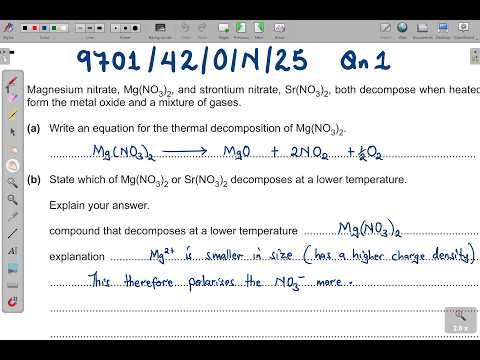 ▶ Whole paper
Video solution of the whole paper · by THE A* CHEMISTRY SOLDIER. Tap the picture to open it on YouTube.
Solutions follow the official Cambridge mark schemes; marks are shown in grey. Videos are from other YouTube channels. Paper codes read component / series / year: M/J = May/June, O/N = October/November. Past-paper questions © UCLES, reproduced for classroom practice.