Q8 · 9700/22/F/M/22 Q2
Worked solution from the The mitotic cell cycle Theory (Paper 2) booklet, Part 1 of 2.

Worked solution
(a)(i)
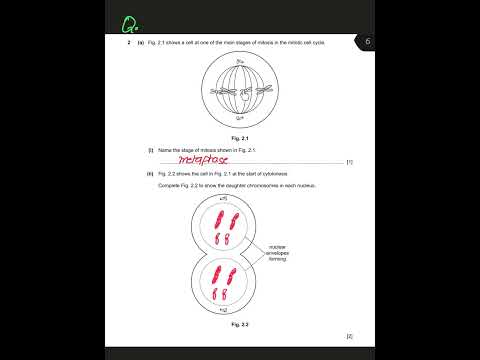
The chromosomes are lined up at the equator on the spindle. Write metaphase. [1]
(a)(ii)
Each cell in Fig. 2.1 had four chromosomes (each of two chromatids). At the start of cytokinesis, the chromatids have separated.
Draw 4 chromosomes inside the dotted nuclear outline of each new cell, each made of one chromatid. [1]
Show two obvious pairs in each nucleus, matching the cell in Fig. 2.1 (for example two long and two short, or two dark and two light). [1]
(b)
Write: telomeres prevent the loss of genes (genetic information) at the ends of chromosomes during replication (or stop the ends of chromosomes joining). [1]
(c)
Think about what stem cells can do (any three).
Stem cells grown in the lab can divide by mitosis to make large numbers. [1]
They are unspecialised (undifferentiated), so when returned they can differentiate into all the types of blood cell. [1]
They replace or re-populate the person's blood cells that were destroyed by the radiation. [1]
Official mark scheme

 ▶ Whole paper
Video solution of the whole paper · by Hussham Arshad. Tap the picture to open it on YouTube.
Solutions follow the official Cambridge mark schemes; marks are shown in grey. Videos are from other YouTube channels. Paper codes read component / series / year: M/J = May/June, O/N = October/November. Past-paper questions © UCLES, reproduced for classroom practice.