Q32 · 9700/42/F/M/22 Q6
Worked solution from the Photosynthesis Theory (Paper 4) booklet, Part 2 of 2.

Worked solution
(a)(i)
Read Fig. 6.2: at 1000 lux the CO2 uptake is about −1.6 μmol m−2 s−1.
The CO2 uptake is negative (CO2 is released). [1]
This is because there is little photosynthesis at this low light intensity. [1]
The rate of respiration is higher than the rate of photosynthesis, so more CO2 is made than used. [1]
(a)(ii)
Between 2000 and 7000 lux the line rises steeply.
As light intensity increases, the rate of CO2 uptake increases. [1]
Quote data: the uptake goes from about −0.2 μmol m−2 s−1 at 2000 lux to about 6.5 μmol m−2 s−1 at 7000 lux. [1]
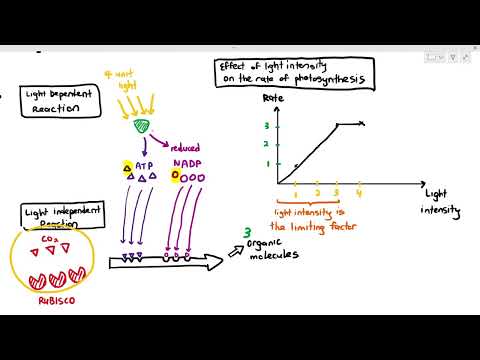
This is because the rate of photosynthesis (light dependent and light independent reactions) increases, so light intensity is the limiting factor. [1]
(a)(iii)
Write: light intensity is no longer limiting; another factor such as CO2 concentration or temperature is now limiting. [1]
(b)(i)
Insects are made of protein, so write: a protease (proteinase or peptidase), a hydrolytic enzyme. [1]
(b)(ii)
Compound that needs nitrogen: amino acids (or proteins, or nucleotides). [1]
Calvin cycle intermediate: glycerate-3-phosphate (GP) or triose phosphate (TP). [1]
Official mark scheme

 ▶ Topic lesson
A lesson on this topic · by OtterBioTutor. Tap the picture to open it on YouTube.
Solutions follow the official Cambridge mark schemes; marks are shown in grey. Videos are from other YouTube channels. Paper codes read component / series / year: M/J = May/June, O/N = October/November. Past-paper questions © UCLES, reproduced for classroom practice.