Q5 · 2059/11/O/N/23 Q1
Worked solution from the The Khilafat Movement Theory (Paper 1) booklet, Part 3 of 3.

Worked solution
(a)
The treaty was meant to punish the Ottoman countries [1]
Land from the Ottoman Empire was divided between the Allies, creating hardship and refugee issues throughout the region [1]
Restrictions limited the size and scope of the Turkish military forces [1]
(b)
Inference 1: Nationalism was well organised. The poster gives the venue (the Maidan), the date and the time of the meeting, and it was produced by the Non-Cooperation Movement.
Inference 2: Nationalism was very popular and growing. The poster invites all to attend a public meeting and asks people to give away foreign clothes for a great bonfire and to wear Swadeshi Khadi, which only works if many people join in.
Inference 3: Muslim and Hindu nationalism were working together. The poster mentions the Karachi Khilafat Conference and congratulates the Ali Brothers, yet it was issued by the Non-Cooperation Movement, which was organised by Hindus under Gandhi. Swadeshi is a Hindu idea like the 1905-1911 movement.
This reaches Level 3 because it gives valid inferences, each supported by a surface feature of Source B and by contextual knowledge. [5]
(c)
Explanation 1: The Movement made Indian people less ready to accept British rule. It also made the Muslim community realise they had political power.
Explanation 2: Muslims began to see that they no longer had to rely on the Hindu community to advance their cause. Socially, a split began to grow between the Muslim and Hindu communities.
Explanation 3: The Muslim community learned the importance of leadership and political organisation. The Movement was seen as an important step towards an independent state.
This reaches Level 3 (explanation): it gives three explanations of the impact, each with its effect on the Muslim community. [7]
(d)
Agree: The Muslim community lost a large amount of support from the Hindu community. Gandhi called off Hindu participation in the Movement, and the Moplah violence against Hindus divided the Muslim and Hindu communities.
Disagree: The Muslim community was demoralised. The Ali brothers and other leaders were imprisoned in 1921, and there were 30 000 political prisoners by 1921.
Disagree: Muslim groups unsuccessfully migrated to Afghanistan in 1920, and Kemal Ataturk abolished the Caliph in 1924, which removed the cause of the Movement.
Judgement: The breakdown of Muslim-Hindu collaboration was a very important reason because it took away much of the Movement's strength. But the abolition of the Caliph in 1924 ended the Movement's purpose, so the breakdown was a main reason but not the only one.
This reaches Level 5: it explains both sides with accurate knowledge and ends with a supported judgement. [10]
Official mark scheme

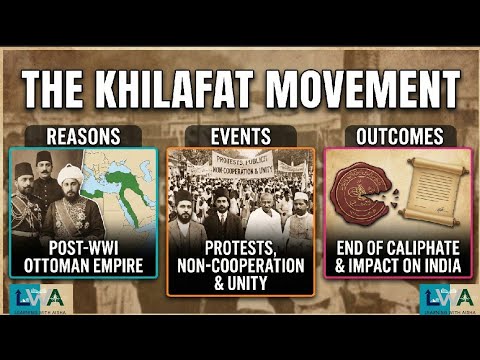 ▶ Topic lesson
A lesson on this topic · by Learning with Aisha. Tap the picture to open it on YouTube.
Solutions follow the official Cambridge mark schemes; marks are shown in grey. Videos are from other YouTube channels. Paper codes read component / series / year: M/J = May/June, O/N = October/November. Past-paper questions © UCLES, reproduced for classroom practice.