Q29 · 9701/42/O/N/25 Q9
Worked solution from the Hydrocarbons Theory (Paper 4) booklet, Part 1 of 1.

Worked solution
(a)
Describe sigma and pi bonds in benzene. Show at least six points across the lines below.
Every carbon is sp2 hybridised. The C–C bonds are σ and π bonds. [1]
C–C σ bonds form by overlap of sp2 hybrid orbitals. C–C π bonds form by overlap of p orbitals. [1]
C–H bonds are σ bonds, formed by overlap of an sp2 orbital with an s orbital. [1]
(b)
Write CH3Cl and AlCl3. [1]
(c)
Curly arrow from inside the ring to +CH3. [1]
Intermediate: horseshoe with +, with H and CH3 on the same carbon. [1]
Curly arrow from the C–H bond into the ring, giving methylbenzene and H+. [1]
(d)
Write concentrated HNO3 and concentrated H2SO4. [1]
Keep the temperature between 25 °C and 60 °C. [1]
(e)
Write alkaline KMnO4 (then heat). [1]
(f)
W has COOH and NO2 opposite each other.
Write 4-nitrobenzoic acid. [1]
(g)
Write tin and concentrated HCl, heated. [1]
(h)
Y has NH2 and COOH on carbons 1 and 3 (meta). NO2 and COOH are 3-directing, so the order of steps must change.
Do step 3 before step 2 (or step 2 before step 1). [1]
Because COOH is 3-directing (or NO2 is 3-directing), the second group goes to the 3 position. [1]
Official mark scheme

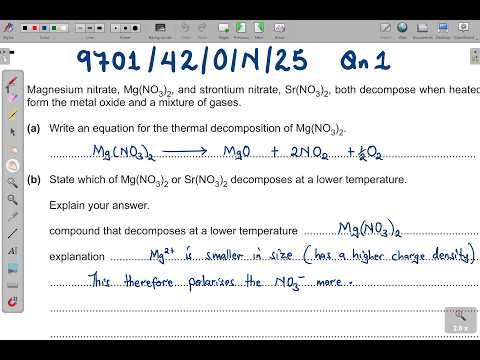 ▶ Whole paper
Video solution of the whole paper · by THE A* CHEMISTRY SOLDIER. Tap the picture to open it on YouTube.
Solutions follow the official Cambridge mark schemes; marks are shown in grey. Videos are from other YouTube channels. Paper codes read component / series / year: M/J = May/June, O/N = October/November. Past-paper questions © UCLES, reproduced for classroom practice.