Q31 · 9708/42/O/N/22 Q2
Worked solution from the The price system and the microeconomy Theory (Paper 4) booklet, Part 4 of 8.

Worked solution
(a)
Explain means: define the terms, link them to private and social costs and benefits, draw each diagram, and give an example of each.
Externalities are spillover costs or benefits that fall on third parties and do not apply to the person who causes them.
Positive externality for a consumer: consuming the good brings a benefit to others as well. So the marginal social benefit (MSB) is greater than the marginal private benefit (MPB). Example: a person having a vaccination or education protects or benefits other people.
Diagram 1: price/cost up and quantity along. Draw a supply curve (MPC = MSC) and a demand curve MPB. Draw a higher curve MSB above MPB. The market is at Q where MPB = MPC. The socially efficient output Qs, where MSB = MSC, is to the right of Q. The market under-consumes the good; shade the welfare loss between Q and Qs.
Negative externality for a producer: production imposes a cost not paid by the producer. So the marginal social cost (MSC) is greater than the marginal private cost (MPC). Example: a factory whose smoke or waste pollutes the local area.
Diagram 2: draw a demand curve (MPB = MSB) and a supply curve MPC. Draw a higher curve MSC above MPC. The market is at Q where MPC = MPB. The socially efficient output Qs, where MSC = MSB, is to the left of Q. The market over-produces; shade the welfare loss between Qs and Q.
Refer to the diagrams in the text: say that the gap between MSB and MPB (or between MSC and MPC) is the external benefit (or cost).
This reaches Level 4: it defines positive and negative externalities, analyses their relationship to social and private costs and benefits, gives appropriate diagrams referred to in the text, and links examples to both types of externality. [12]
(b)
Discuss means: say why externalities explain some market failure, why they do not explain all of it, using other forms of market failure, then conclude.
Market failure is when the free market fails to allocate resources efficiently. Externalities explain some cases: the market ignores spillover costs and benefits, so output is wrong (too high or too low).
Externalities do not explain all market failure. Other forms include:
Public goods: goods that are non-excludable and non-rival. Because people can free ride, private firms cannot charge, so the market does not provide them (or provides too few). This is failure because of a missing market, not because of an externality.
Non-perfect competition: monopoly and other imperfect markets can fail to achieve productive efficiency and allocative efficiency: they restrict output and charge higher prices than in perfect competition, so price is above marginal cost.
Under-employment of resources: the market may leave labour and capital unemployed or not fully used, so output is below its potential.
Inequality: the market may give an unequal distribution of income and goods, which society may see as unfair.
Conclusion: externalities explain an important part of market failure, but not all of it. Public goods and imperfect competition (and unemployment and inequality) are separate causes, so the statement is only partly right.
This reaches Level 4: it develops an analysis of two alternative forms of market failure and reaches a conclusion. [13]
Official mark scheme

 ▶ Topic lesson
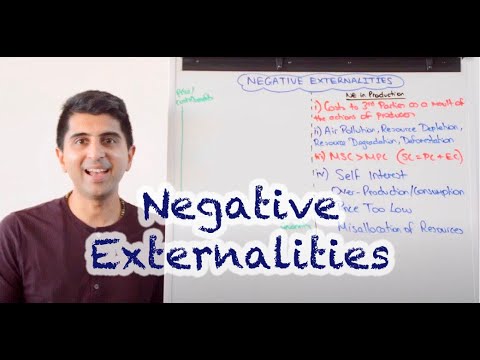
A lesson on this topic · by EconplusDal. Tap the picture to open it on YouTube.
Solutions follow the official Cambridge mark schemes; marks are shown in grey. Videos are from other YouTube channels. Paper codes read component / series / year: M/J = May/June, O/N = October/November. Past-paper questions © UCLES, reproduced for classroom practice.