Q7 · 9701/22/M/J/21 Q1
Worked solution from the Group 17 Theory (Paper 2) booklet, Part 3 of 4.

Worked solution
(a)
Silver ions with bromide ions make silver bromide.
Colour: cream. [1]
Formula: AgBr. [1]
(b)
Balance with two Ag+ for two Br–.
Write: MBr2 + 2AgNO3 → 2AgBr + M(NO3)2 [1]
(c)
Mr = mass ÷ moles = 0.250 ÷ 8.415 × 10–4 = 297.1 [1]
Ar of M = 297.1 − (2 × 79.9) = 297.1 − 159.8 = 137.3 [1]
The Group 2 metal with Ar about 137 is Ba (barium). [1]
(d)(i)
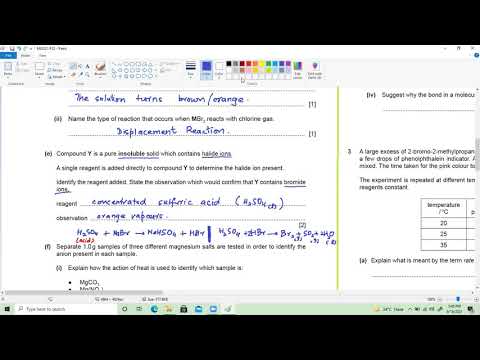
Chlorine displaces bromine. The solution turns orange or brown. [1]
(d)(ii)
The type of reaction is displacement (also redox). [1]
(e)
Y is insoluble, so silver nitrate will not work well. Use a reagent that oxidises the halide.
Reagent: concentrated sulfuric acid. [1]
Observation: brown vapour (gas) forms. [1]
(f)(i)
Heat each 1.0 g sample and watch what happens.
MgCO3 and Mg(NO3)2 both lose mass (end with less than 1 g). [1]
Mg(NO3)2 gives brown fumes of NO2. [1]
MgO shows no reaction (no change). [1]
(f)(ii)
Mg has 12 electrons, so Mg2+ has 10.
Write: 1s2 2s22p6 [1]
(g)
Similarity: the solid disappears (dissolves) in both. [1]
Difference: MgCO3 fizzes (CO2 is given off), but Mg(OH)2 does not. [1]
Official mark scheme

 ▶ Whole paper
Video solution of the whole paper · by Ehsan Khan. Tap the picture to open it on YouTube.
Solutions follow the official Cambridge mark schemes; marks are shown in grey. Videos are from other YouTube channels. Paper codes read component / series / year: M/J = May/June, O/N = October/November. Past-paper questions © UCLES, reproduced for classroom practice.