Q51 · 9701/13/M/J/23 Q9
Worked solution from the States of matter MCQ booklet.

Worked solution
We need the reason buckminsterfullerene (C60) has a lower melting point than graphite.
Melting C60 only needs weak forces between separate molecules to be overcome. Little energy is needed.
Melting graphite needs many strong covalent bonds to be broken in its giant structure, which takes much more energy.
The explanation is that C60 exists as discrete molecules with weak intermolecular bonding.
So the answer is A.
B is wrong because graphite is not ionic. C is wrong because strained bonds don't explain the difference. D is wrong because delocalised electrons do not make graphite metallic.
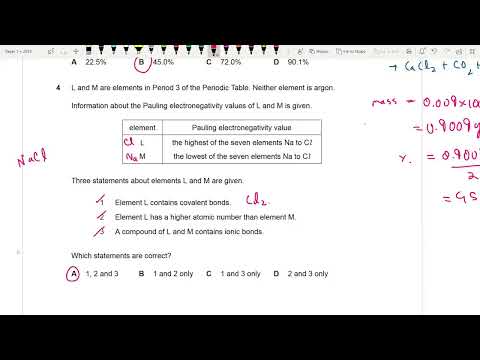 ▶ Whole paper
Video solution of the whole paper · by CAIE PAPERS SOLVED. Tap the picture to open it on YouTube.
Solutions follow the official Cambridge mark schemes. Videos are from other YouTube channels. Paper codes read component / series / year: M/J = May/June, O/N = October/November. Past-paper questions © UCLES, reproduced for classroom practice.