Q29 · 5070/21/O/N/20 Q6
Worked solution from the Organic chemistry Theory (Paper 2) booklet, Part 5 of 7.

Worked solution
(a)(i)
Compare the densities: 0.791, 0.789, 0.803, 0.810, 0.814.
Write: the density increases (generally) as the number of carbon atoms increases. [1]
(a)(ii)
Write: the boiling point increases because the forces of attraction between molecules (intermolecular forces) get stronger as the molecules get bigger. [1]
(b)(i)
Write: a strong acid is completely ionised (dissociated) in water. [1]
(b)(ii)
An ester name comes from the alcohol first, then the acid. Alcohol is ethanol (ethyl) and acid is butanoic (butanoate).
Write the name ethyl butanoate. [1]
Draw it with all atoms and bonds: CH3CH2CH2–C(=O)–O–CH2CH3, so the C=O carbon is joined to O, which is joined to the CH2CH3 group. [1]
(c)
Write the reagent: acidified potassium manganate(VII). [1]
Write the condition: heat under reflux (heat). [1]
(d)(i)
Calcium is 2+ and each ethanoate is 1−, so 2 acid molecules react with 1 calcium.
Write 2CH3CO2H + Ca → (CH3CO2)2Ca + H2 [1]
(d)(ii)
Dilute acid has fewer acid particles in the same volume.
Write: the rate decreases because there are fewer particles in a given volume. [1]
So there are fewer collisions per second (less frequent collisions). [1]
Official mark scheme

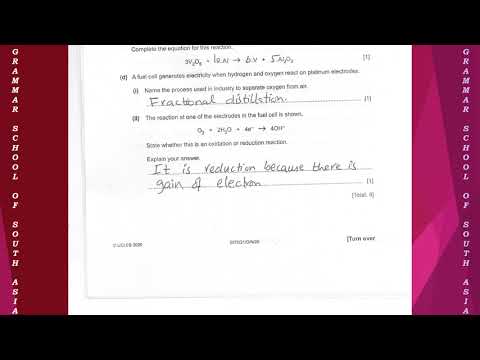 ▶ Whole paper
Video solution of the whole paper · by A Levels Academy Islamabad. Tap the picture to open it on YouTube.
Solutions follow the official Cambridge mark schemes; marks are shown in grey. Videos are from other YouTube channels. Paper codes read component / series / year: M/J = May/June, O/N = October/November. Past-paper questions © UCLES, reproduced for classroom practice.