Q1 · 9700/42/F/M/20 Q9
Worked solution from the Inheritance Theory (Paper 4) booklet, Part 1 of 3.

Worked solution
(a)
Write about meiosis, then fertilisation; any eight points in total.
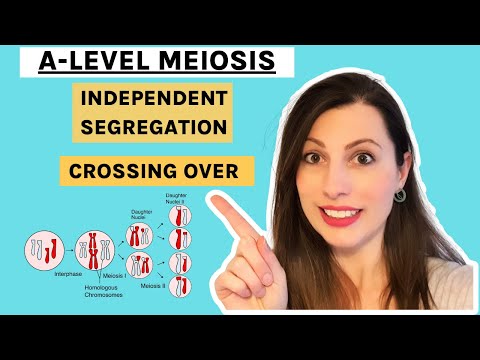
Crossing over (a chiasma forms) happens between non-sister chromatids of homologous chromosomes (a bivalent) in prophase I. [1]
This causes an exchange of genetic material (alleles / genes / DNA). [1]
It breaks linkage groups and makes a new combination of alleles. [1]
Independent (random) assortment of homologous chromosomes / bivalents at the equator happens in metaphase I. [1]
Each gamete gets a different mix of maternal and paternal chromosomes. [1]
Independent assortment of sister chromatids / chromosomes also happens in metaphase II. [1]
Chromosome mutation (for example non-disjunction) may also occur. [1]
Random mating, and random fusion (fertilisation) of gametes, so any male gamete can join any female gamete. [1]
(b)
Give up to four points for each disease (max 4 each); seven marks in total.
Albinism is caused by a recessive allele. [1]
The mutant allele means faulty tyrosinase is made / tyrosinase is not made. [1]
So there is an absence or reduced production of melanin. [1]
This gives pale / white hair or skin and pink eyes, and increased susceptibility to sunburn / skin cancer (any one of these). [1]
Haemophilia is caused by a recessive allele on the X chromosome, so it is sex-linked. [1]
The mutant allele means factor VIII (or factor IX) is not produced, so blood clotting is prevented or reduced. [1]
Write the symptoms: excessive bleeding, bleeding into joints, large bruises or internal bleeding (any one). [1]
Official mark scheme

 ▶ Topic lesson
A lesson on this topic · by Miss Estruch Biology. Tap the picture to open it on YouTube.
Solutions follow the official Cambridge mark schemes; marks are shown in grey. Videos are from other YouTube channels. Paper codes read component / series / year: M/J = May/June, O/N = October/November. Past-paper questions © UCLES, reproduced for classroom practice.