Q36 · 5090/12/O/N/23 Q35
Worked solution from the Inheritance MCQ booklet.

Worked solution
The question asks for the genotypes of M and N for polydactyly, where E (extra fingers) is dominant to e.
N is a woman without extra fingers. Her phenotype is recessive, so N is ee.
M is a man with extra fingers, so he has at least one E. M and N have children, and some of them (a daughter and a son) do not have extra fingers, so they are ee.
Each ee child must have got one e allele from M. So M must carry an e allele as well as E, so M is Ee.
So M is Ee and N is ee.
So the answer is C.
A is wrong because EE would give all children extra fingers. B is wrong because N has no extra fingers, so she cannot have E. D is wrong because M has extra fingers, so he must have E.
 ▶ Whole paper
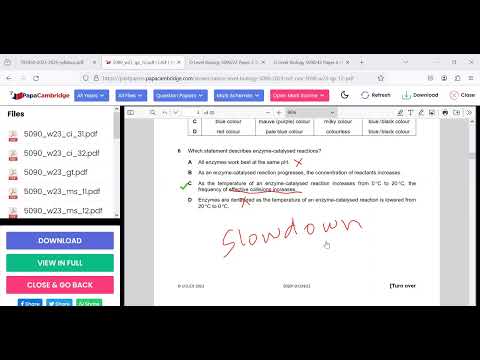
Video solution of the whole paper · by bushra taimoor. Tap the picture to open it on YouTube.
Solutions follow the official Cambridge mark schemes. Videos are from other YouTube channels. Paper codes read component / series / year: M/J = May/June, O/N = October/November. Past-paper questions © UCLES, reproduced for classroom practice.