Q21 · 0620/43/O/N/25 Q1
Worked solution from the Atoms, elements and compounds Theory (Paper 4) booklet, Part 1 of 6.

Worked solution
(a)
Neutrons have no charge. Protons are +1. Both have a relative mass of 1.
Write neutron: charge 0, mass 1. [1]
Write proton: charge +1, mass 1. [1]
(b)
4020Ca2+: protons 20, but the 2+ ion has lost 2 electrons, so electrons = 20 − 2 = 18. [1]
199F: neutrons = 19 − 9 = 10. [1]
Last row: 8 protons means oxygen. Nucleon number = 8 + 9 = 17. Write 17 above the 8 to the left of the symbol. [1]
Write the symbol O. [1]
It has 10 electrons but 8 protons, so it has gained 2 electrons. Write the charge 2−. [1]
(c)(i)
All relative atomic masses are compared to the same standard isotope.
Write 12C (carbon-12). [1]
(c)(ii)
Let x be the % of Mg-24. Then Mg-26 is (100 − x)%.
(24 × x) + (26 × (100 − x)) = 24.3 × 100 = 2430
2600 − 2x = 2430, so 2x = 170
x = 85 %. [1]
Official mark scheme

 ▶ Whole paper
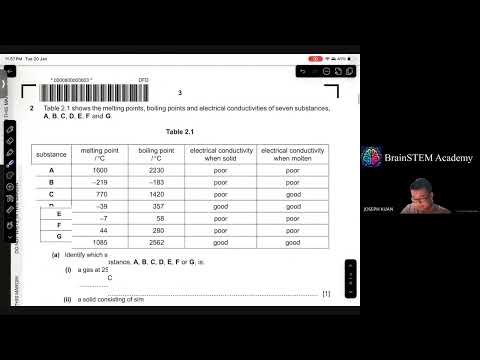
Video solution of the whole paper · by Teacher Joseph Kuan - IGCSE Chemistry Online Tutor. Tap the picture to open it on YouTube.
Solutions follow the official Cambridge mark schemes; marks are shown in grey. Videos are from other YouTube channels. Paper codes read component / series / year: M/J = May/June, O/N = October/November. Past-paper questions © UCLES, reproduced for classroom practice.