Q7 · 9701/42/O/N/20 Q2
Worked solution from the Equilibria Theory (Paper 4) booklet, Part 1 of 2.

Worked solution
(a)
Ka is the equilibrium constant for HA ⇌ H+ + A−. Products go on top, the acid goes underneath.
Write Ka = [H+][A−] / [HA] [1]
(b)(i)
The acid is weak, so pH gives [H+] directly. Each HONH3+ that dissociates gives one H+ and one HONH2, so [H+] = [HONH2].
[H+] = 10−4.41 = 3.9 × 10⁻⁵ mol dm−3 [1]
Ka = [H+]2 / [HONH3+] = (3.9 × 10⁻⁵)2 / 1.00 × 10⁻³
Write Ka = 1.5 × 10⁻⁶ mol dm−3 [1]
(b)(ii)
pKa = −log Ka = −log(1.5 × 10⁻⁶)
Write pKa = 5.82 [1]
(c)
Mn(OH)2(s) ⇌ Mn2+ + 2OH−. If the solubility is x, then [Mn2+] = x and [OH−] = 2x.
Ksp = x(2x)2 = 4x3 = 1.1 × 10⁻¹¹ [1]
x3 = 2.75 × 10⁻¹², so write x = 1.4 × 10⁻⁴ mol dm−3 [1]
Official mark scheme

 ▶ Whole paper
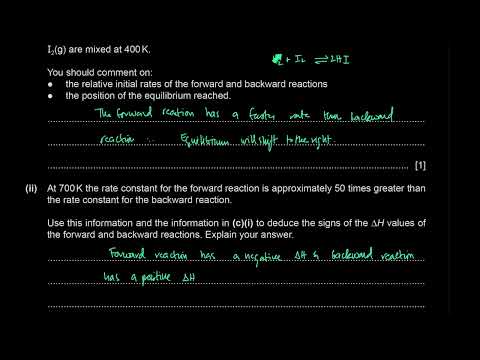
Video solution of the whole paper · by Abdullah Ghelli. Tap the picture to open it on YouTube.
Solutions follow the official Cambridge mark schemes; marks are shown in grey. Videos are from other YouTube channels. Paper codes read component / series / year: M/J = May/June, O/N = October/November. Past-paper questions © UCLES, reproduced for classroom practice.