Q72 · 9701/11/M/J/23 Q24
Worked solution from the An introduction to AS Level organic chemistry MCQ booklet.

Worked solution
We need every isomer of C7H14O that has a five-membered carbon ring and a tertiary alcohol. Stereoisomers count too.
C7H14O with one ring and no C=C fits a cyclopentane ring plus two more carbons and an OH group. For a tertiary alcohol the C–OH carbon must be joined to three other carbons, so the OH must sit on a ring carbon that also carries a substituent.
Option 1: OH and an ethyl group on the same ring carbon: 1-ethylcyclopentan-1-ol. This has no chiral centre. 1 isomer.
Option 2: OH and one CH3 on the same ring carbon, with a second CH3 on the next ring carbon: 1,2-dimethylcyclopentan-1-ol. It has two different chiral centres, so 4 optical isomers.
Option 3: OH and one CH3 on the same ring carbon, with a second CH3 two carbons away: 1,3-dimethylcyclopentan-1-ol. It also has two different chiral centres, so 4 isomers.
Total = 1 + 4 + 4 = 9.
So the answer is C.
A, B and D come from missing some of the stereoisomers, or counting structures that are not tertiary alcohols.
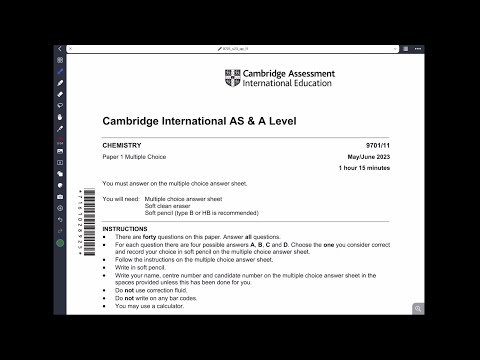 ▶ Whole paper
Video solution of the whole paper · by JMXZ. Tap the picture to open it on YouTube.
Solutions follow the official Cambridge mark schemes. Videos are from other YouTube channels. Paper codes read component / series / year: M/J = May/June, O/N = October/November. Past-paper questions © UCLES, reproduced for classroom practice.