Q20 · 9700/42/M/J/22 Q9
Worked solution from the Homeostasis Theory (Paper 4) booklet, Part 1 of 2.

Worked solution
(a)
The efferent vessel is narrower, so blood is squeezed and pressure builds up in the glomerulus.
Write: the wide afferent vessel lets blood in faster than it leaves, giving a high blood (hydrostatic) pressure. [1]
This pressure forces plasma (water) through the basement membrane into the Bowman's capsule. [1]
(b)(i)
In Fig. 9.1, A is the thin layer between the capillary and the cells with projections, and B is the cell with finger-like projections.
A is the basement membrane. [1]
B is a podocyte. [1]
(b)(ii)
Any three of these:
A (basement membrane) acts as a filter (filtration barrier). [1]
Only small molecules (named, e.g. glucose, water, ions) can pass through; red blood cells and large proteins cannot. [1]
B (podocyte) has gaps (slits / pores) between its projections. [1]
These allow the filtrate (fluid) to pass into the lumen of the Bowman's capsule; podocytes also produce the basement membrane.
(Write any three points; only three marks are available.)
Official mark scheme

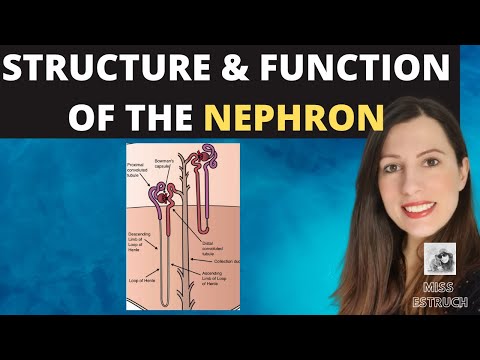 ▶ Topic lesson
A lesson on this topic · by Miss Estruch Biology. Tap the picture to open it on YouTube.
Solutions follow the official Cambridge mark schemes; marks are shown in grey. Videos are from other YouTube channels. Paper codes read component / series / year: M/J = May/June, O/N = October/November. Past-paper questions © UCLES, reproduced for classroom practice.