Q28 · 9701/13/M/J/23 Q12
Worked solution from the Chemical energetics MCQ booklet.

Worked solution
First find which reactant limits the amount of reaction.
Moles HNO3 = 0.0200 dm3 × 4.00 = 0.0800 mol. Moles NaOH = 0.0300 dm3 × 2.00 = 0.0600 mol. NaOH is limiting, so 0.0600 mol of water forms.
Heat released = 0.0600 × 57.0 = 3.42 kJ = 3420 J
Total volume = 20.0 + 30.0 = 50.0 cm3. Heat capacity of the mixture = 50.0 × 4.2 = 210 J °C−1
Temperature rise = 3420 ÷ 210 = 16.3 °C
Final temperature = 25.0 + 16.3 = 41.3 °C
So the answer is A.
The other options come from wrong moles or volume. For example, using 0.0800 mol (the HNO3) gives 4560 ÷ 210 = 21.7 °C, so 46.7 °C (C). Using only the 30.0 cm3 of NaOH gives 3420 ÷ 126 = 27.1 °C, so 52.1 °C (D).
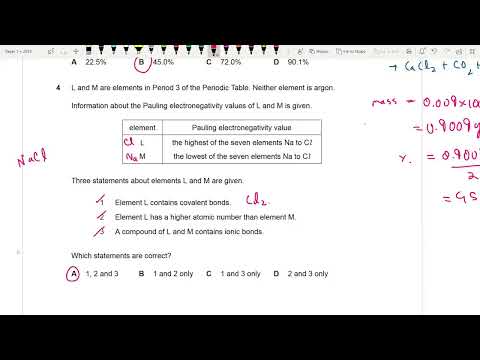 ▶ Whole paper
Video solution of the whole paper · by CAIE PAPERS SOLVED. Tap the picture to open it on YouTube.
Solutions follow the official Cambridge mark schemes. Videos are from other YouTube channels. Paper codes read component / series / year: M/J = May/June, O/N = October/November. Past-paper questions © UCLES, reproduced for classroom practice.