Q14 · 9700/43/M/J/21 Q2
Worked solution from the Energy and respiration Theory (Paper 4) booklet, Part 2 of 2.

Worked solution
(a)(i)
Ions are moved into the cell against their concentration gradient using ATP.
Write: active transport. [1]
(a)(ii)
Energy made into ATP = 31 × 30.5 = 945.5 kJ mol−1
Efficiency = 945.5 ÷ 2870 × 100 = 32.94% (32.9% or 33% is accepted) [2]
(a)(iii)
Heat from respiration helps to keep a steady body temperature.
Write: thermoregulation (maintaining a constant body or core temperature). [1]
(a)(iv)
In the Krebs cycle ATP is made directly from an intermediate, not by the electron transport chain.
Write: substrate-linked phosphorylation (substrate level phosphorylation). [1]
(b)
Read the RQ values from Fig. 2.1: 0.8 at rest, 1.0 at 110 J s−1, 1.2 at 200 J s−1.
RQ at rest (0.8): a mix of respiratory substrates is respired (lipids and carbohydrates or proteins). [1]
RQ at 110 J s−1 (1.0): carbohydrate (for example glucose) is the substrate being respired. [1]
RQ at 200 J s−1 (1.2): anaerobic respiration is also occurring. [1]
This is because less oxygen is available, or more CO2 is produced or released than the oxygen taken in. [1]
(c)
After exercise the person has an oxygen debt. [1]
Extra oxygen is needed to convert lactate to pyruvate (or to glycogen). [1]
Extra oxygen is also needed to re-oxygenate haemoglobin / myoglobin (or to support a higher metabolic rate, EPOC). [1]
Official mark scheme

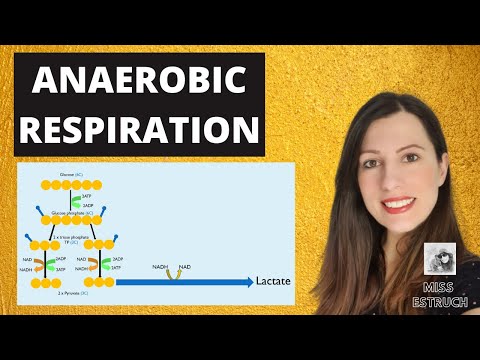 ▶ Topic lesson
A lesson on this topic · by Miss Estruch Biology. Tap the picture to open it on YouTube.
Solutions follow the official Cambridge mark schemes; marks are shown in grey. Videos are from other YouTube channels. Paper codes read component / series / year: M/J = May/June, O/N = October/November. Past-paper questions © UCLES, reproduced for classroom practice.