Q33 · 9701/42/F/M/22 Q1
Worked solution from the Equilibria Theory (Paper 4) booklet, Part 2 of 2.

Worked solution
(a)(i)
I− loses electrons to become I2, so H2O2 gains them.
Write the role: oxidising agent. [1]
Write H2O2 + 2H+ + 2I− → 2H2O + I2 [1]
(a)(ii)
Kpc = [I2 in C6H12] / [I2 in water]. Let x be the mass left in water.
93.8 = (0.390 / 15) ÷ (x / 20) [1]
x = 0.390 × 20 / (15 × 93.8) = 5.54 × 10⁻³ g [1]
(a)(iii)
Think about polarity. I2 is non-polar.
Write that Kpc would be lower.
Hexan-2-one is more polar than cyclohexane (cyclohexane is non-polar).
So I2 is less soluble in hexan-2-one.
Two of these three points score [1]. All three points score [2].
(b)(i)
Write: the enthalpy change when one mole of a solute dissolves in water to form a solution of infinite dilution. [1]
(b)(ii)
Solution = −(lattice formation) + hydration of K+ + hydration of I−
−(−629) + (−322) + (−293) = +14 kJ mol−1 [1]
(b)(iii)
Down the group the cation gets bigger.
Cation charge density decreases from Li+ to K+. [1]
So lattice energies get less negative (less exothermic) because there is less attraction between the ions. [1]
(c)(i)
From the equations: 2S2O32− ≡ 1 I2 ≡ 2Cu2+, so moles Cu2+ = moles thiosulfate.
Moles thiosulfate = 0.02230 × 0.150 = 3.345 × 10⁻³ [1]
[Cu2+] = 3.345 × 10⁻³ / 0.0250 = 0.134 mol dm−3 [1]
(c)(ii)
Write starch. [1]
(c)(iii)
A 3dxy orbital has four lobes lying in the xy plane, pointing between the x and y axes (not along them).
Draw four lobes in the xy plane, between the axes, with the centre at the origin. [1]
(d)
Fe3+ is reduced by I−, then regenerated by S2O82−.
2Fe3+ + 2I− → 2Fe2+ + I2 [1]
2Fe2+ + S2O82− → 2Fe3+ + 2SO42− [1]
(e)
Convert g dm−3 to mol dm−3, then use HgI2 ⇌ Hg2+ + 2I−.
[Hg2+] = 1.00 × 10⁻⁷ / 454.4 = 2.20 × 10⁻¹⁰ mol dm−3 [1]
Ksp = [Hg2+][I−]2 = 4[Hg2+]3 = 4 × (2.20 × 10−10)3 = 4.26 × 10⁻²⁹ [1]
Units: mol3 dm−9 [1]
Official mark scheme

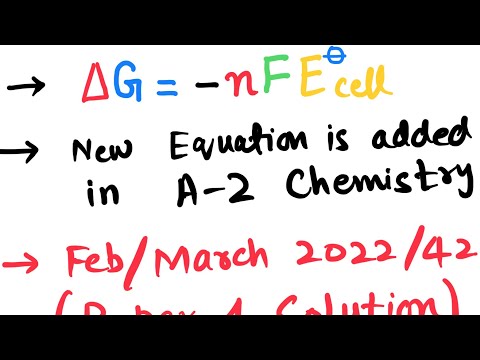 ▶ Whole paper
Video solution of the whole paper · by ChemBridge. Tap the picture to open it on YouTube.
Solutions follow the official Cambridge mark schemes; marks are shown in grey. Videos are from other YouTube channels. Paper codes read component / series / year: M/J = May/June, O/N = October/November. Past-paper questions © UCLES, reproduced for classroom practice.