Q5 · 9701/42/O/N/20 Q3
Worked solution from the Group 2 Theory (Paper 4) booklet, Part 1 of 1.

Worked solution
(a)(i)
W goes from Ca(s) + Cl2(g) to Ca2+(g) + 2Cl–(g). Add up atomisation, ionisation energies, bond energy and electron affinity. Data Booklet: Ca IE1 = +590, IE2 = +1150, Cl–Cl bond = +242.
W = (+193) + (+590) + (+1150) + (+242) + (2 × –349) [1]
W = +1477 kJ mol–1 [1]
(a)(ii)
Z goes from the gaseous ions to CaCl2(aq). Use Hess's law: Z = X + Y – W, with X = formation and Y = solution.
Z = –795 + (–83) – 1477 [1]
Z = –2355 kJ mol–1 [1]
(a)(iii)
Z is the hydration of one Ca2+ and two Cl–. Subtract the chloride hydration.
ΔHhyd(Ca2+) = –2355 – (2 × –364) [1]
= –1627 kJ mol–1 [1]
(a)(iv)
Lattice energy goes from the gaseous ions to CaCl2(s). In the cycle, that means going down W backwards and then down X. So the lattice energy is X – W. It is also Z – Y.
Write: lattice energy = X – W (or Z – Y). [1]
(a)(v)
Compare the ion sizes of CaCl2 and MgF2.
Less exothermic, because both ions in CaCl2 are larger (Ca2+ bigger than Mg2+, Cl– bigger than F–). [1]
(b)(i)
Mix a soluble barium salt with a soluble sulfate.
Write barium chloride (or barium nitrate) solution and sodium sulfate (or magnesium sulfate) solution. [1]
(b)(ii)
Give the trend and reason using enthalpies.
The sulfates become less soluble down the group. [1]
Lattice energy and hydration enthalpy both become less exothermic. [1]
The hydration enthalpy changes more (it is the dominant factor). [1]
So the enthalpy change of solution becomes less exothermic (more endothermic). [1]
Official mark scheme

 ▶ Whole paper
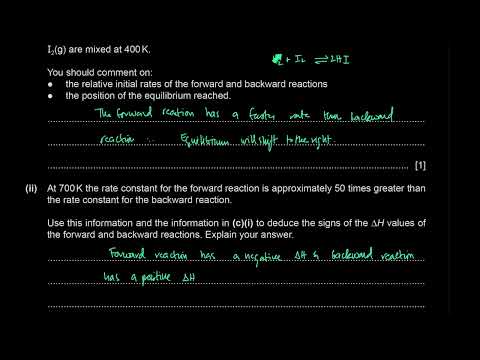
Video solution of the whole paper · by Abdullah Ghelli. Tap the picture to open it on YouTube.
Solutions follow the official Cambridge mark schemes; marks are shown in grey. Videos are from other YouTube channels. Paper codes read component / series / year: M/J = May/June, O/N = October/November. Past-paper questions © UCLES, reproduced for classroom practice.