Q2 · 9701/23/M/J/21 Q1
Worked solution from the Group 17 Theory (Paper 2) booklet, Part 2 of 4.

Worked solution
(a)(i)
Van der Waals' forces depend on how many electrons a molecule has. Bigger molecules have more electrons.
Write that the forces increase down Group 17. [1]
(a)(ii)
Think of the halogens at room temperature: Cl2 is a pale green gas, Br2 is a red-brown liquid, I2 is a grey-black solid.
Write: chlorine = gas, bromine = liquid, iodine = solid. All three needed. [1]
(b)
Br− is oxidised to Br2 only if the halogen added is a stronger oxidising agent than bromine.
Cl2(aq) is stronger than Br2, so it oxidises Br−. Observation with Cl2(aq): the colour changes to orange / brown (from colourless or pale green). [1]
I2 is weaker than Br2, so it cannot oxidise Br−. Observation with I2(aq): no visible change. [1]
Explanation: chlorine is a stronger oxidising agent than bromine, and iodine is a weaker oxidising agent than bromine. [1]
(c)
Cold dilute NaOH gives chloride and chlorate(I) (disproportionation of chlorine).
Cl2 + 2NaOH → NaCl + NaClO + H2O [1]
(d)(i)
A Brønsted-Lowry base is a proton (H+) acceptor. [1]
(d)(ii)
ClO− takes H+ from water, leaving OH−.
ClO− + H2O → HClO + OH− [1]
(e)
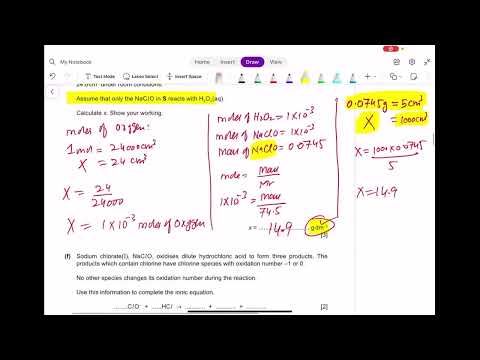
Moles of O2 = 24.0 / 24 000 = 1.00 × 10⁻³ mol [1]
The equation is 1 : 1, so moles NaClO in 5.00 cm3 = 1.00 × 10⁻³ mol.
Moles in 1000 cm3 = 1.00 × 10−3 × 1000 / 5 = 0.200 mol dm−3 [1]
Mr of NaClO = 23.0 + 35.5 + 16.0 = 74.5
x = 0.200 × 74.5 = 14.9 g dm−3 [1]
(f)
ClO− contains Cl at +1. The products with Cl have oxidation number −1 or 0, so they are Cl− and Cl2. The third product is H2O.
Write that the products are Cl− and Cl2 (and water). [1]
Balanced equation: ClO− + 2HCl → Cl− + H2O + Cl2 [1]
Official mark scheme

 ▶ Whole paper
Video solution of the whole paper · by ChemBridge. Tap the picture to open it on YouTube.
Solutions follow the official Cambridge mark schemes; marks are shown in grey. Videos are from other YouTube channels. Paper codes read component / series / year: M/J = May/June, O/N = October/November. Past-paper questions © UCLES, reproduced for classroom practice.