Q49 · 0620/43/O/N/25 Q4
Worked solution from the Chemical reactions Theory (Paper 4) booklet, Part 3 of 4.

Worked solution
(a)(i)
At equilibrium the reaction is still going in both directions.
The rates of the forward and reverse reactions are equal. [1]
The concentrations of reactants and products are no longer changing. [1]
(a)(ii)
Lower pressure means the particles are further apart, so collisions are less frequent: the rate of the forward reaction decreases. [1]
Lower pressure shifts the equilibrium to the side with more gas molecules (the left: 2 on the left, 1 on the right), so the concentration of PCl5 decreases. [1]
A catalyst does not change the position of equilibrium: no change. [1]
(a)(iii)
Raising the temperature moves the equilibrium to the endothermic side. PCl5 decreases, so the reverse reaction is endothermic.
Write: the forward reaction is exothermic. [1]
(b)
Bonds broken: 1 C=C, 4 C–H and 1 Cl–Cl.
Energy to break = 610 + (4 × 410) + 240 = 610 + 1640 + 240 = 2490 kJ [1]
Bonds formed in CH2ClCH2Cl: 1 C–C, 4 C–H and 2 C–Cl.
Energy released = 350 + 1640 + (2 × 340) = 350 + 1640 + 680 = 2670 kJ [1]
ΔH = 2490 − 2670 = −180 kJ/mol [1]
(c)
N has 5 outer electrons and Cl has 7. Each Cl shares one pair with N.
Draw 3 shared pairs (a dot and a cross) in the overlaps between N and each Cl. [1]
Draw one lone pair on the N atom to complete its octet. [1]
Draw three lone pairs on each Cl atom to complete each octet. [1]
(d)(i)
Think about what you would see.
The solid disappears. [1]
Fizzing (bubbles, effervescence) of gas. [1]
(d)(ii)
Moles of HCl = volume (dm3) × concentration = 0.0500 × 0.100 = 0.005 mol [1]
From the equation, 2 mol HCl gives 1 mol CO2. Moles of CO2 = 0.005 ÷ 2 = 0.0025 mol [1]
Volume = 0.0025 × 24 000 = 60 cm3 [1]
Official mark scheme

 ▶ Whole paper
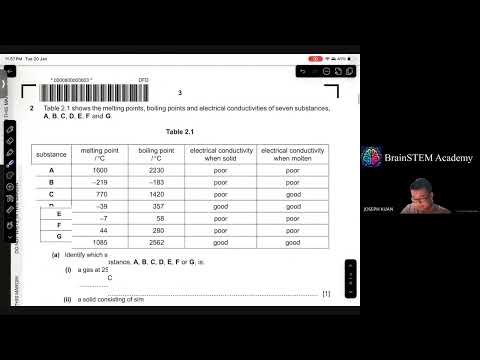
Video solution of the whole paper · by Teacher Joseph Kuan - IGCSE Chemistry Online Tutor. Tap the picture to open it on YouTube.
Solutions follow the official Cambridge mark schemes; marks are shown in grey. Videos are from other YouTube channels. Paper codes read component / series / year: M/J = May/June, O/N = October/November. Past-paper questions © UCLES, reproduced for classroom practice.