Q4 · 2059/11/O/N/21 Q2
Worked solution from the The Khilafat Movement Theory (Paper 1) booklet, Part 3 of 3.

Worked solution
(a)
The battle was fought in 1764 between British forces led by Hector Munro and the Indian army at Buxar (Baksar) [2]
The Indian side was made up of the Nawab of Bengal (Mir Qasim), Shah Alam II and the Nawab of Oudh [1]
There were about 1000 British casualties and 6000 Indian casualties, and the battle confirmed British authority over Bengal [1]
(b)
Explanation 1: Sir Syed foresaw the potential power of the Hindu community in India. He therefore wanted the Muslim community to be on good terms with the British, who ruled the country.
Explanation 2: He believed that the Muslim community was not responsible for the War of Independence. Improving relations would show this and help to prevent any future suffering of the Muslim community.
Explanation 3: He wanted the Muslim community to prosper, with better social and economic conditions and improved educational opportunities. Better relations with the British would make this possible.
This reaches Level 3 (explanation): it gives three explanations, each with the reason that makes it an explanation. [7]
(c)
Agree: The Ali brothers (Mohammed Ali and Shaukat Ali) and Maulana Azad were the leaders of the Movement. The Ali brothers and other leaders were imprisoned in 1921, and the Movement lost direction as a result.
Disagree: Muslim groups migrated to Afghanistan in 1920, which weakened support. The Moplah uprising took place in 1921, and Gandhi withdrew his support in 1922, so Hindu help was lost.
Disagree: Kemal Ataturk abolished the Caliph in 1924, so the Movement no longer had a cause to fight for. The strength of the British response to events also hurt it, and Muhammad Ali Jinnah did not actively support the Movement.
Judgement: The imprisonment of the leaders was an important cause because it left the Movement without direction. However, it came in 1921 and the Movement carried on until 1924. The abolition of the Caliph in 1924 removed the Movement's whole purpose, so this was the main reason and the imprisonment was only one of several causes.
This reaches Level 5: it explains both sides with accurate knowledge and ends with a developed, supported judgement. [14]
Official mark scheme

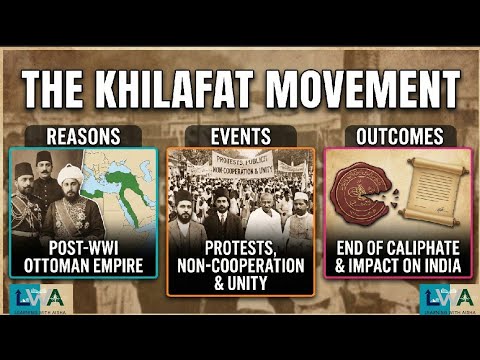 ▶ Topic lesson
A lesson on this topic · by Learning with Aisha. Tap the picture to open it on YouTube.
Solutions follow the official Cambridge mark schemes; marks are shown in grey. Videos are from other YouTube channels. Paper codes read component / series / year: M/J = May/June, O/N = October/November. Past-paper questions © UCLES, reproduced for classroom practice.