Q1 · 9700/42/F/M/20 Q1
Worked solution from the Homeostasis Theory (Paper 4) booklet, Part 1 of 2.

Worked solution
(a)(i)
Look at Fig. 1.1. A points to the finger-like folds on the lumen side of the pct cells. B points to the thin join between two neighbouring cells, next to the lumen.
Write: A = microvilli (also accepted: brush border). [1]
Write: B = tight junction. [1]
(a)(ii)
C is where glucose enters with sodium ions from the lumen. This is the carrier protein in the membrane of the microvilli. Draw a label line from the letter C to the membrane of a microvillus. [1]
D is where sodium ions are pumped out of the cell by active transport. This is the cell surface membrane on the side nearest the blood capillary (up to the tight junction). Draw a label line from the letter D to that membrane of any pct cell. [1]
(b)
Table 1.1 says 99.4% of the sodium ions are reabsorbed, so the amount excreted is the rest.
Reabsorbed = 25 200.0 × 99.4 ÷ 100 = 25 048.8 arbitrary units [1]
Excreted = 25 200.0 − 25 048.8 = 151.2 arbitrary units (to one decimal place). [1]
(c)
The dip stick has two enzymes that work one after the other.
Glucose oxidase oxidises (converts) glucose to gluconic acid and hydrogen peroxide (gluconolactone is also accepted for gluconic acid). [1]
Peroxidase catalyses a reaction between hydrogen peroxide and a chromogen (colourless compound) to make a coloured compound. [1]
Official mark scheme

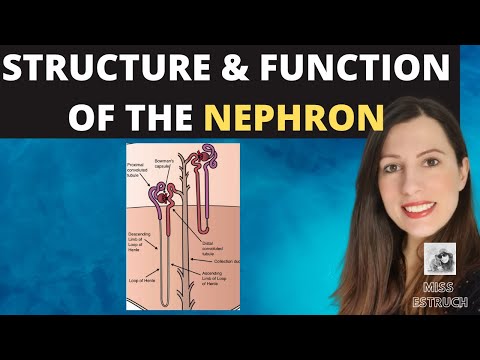 ▶ Topic lesson
A lesson on this topic · by Miss Estruch Biology. Tap the picture to open it on YouTube.
Solutions follow the official Cambridge mark schemes; marks are shown in grey. Videos are from other YouTube channels. Paper codes read component / series / year: M/J = May/June, O/N = October/November. Past-paper questions © UCLES, reproduced for classroom practice.