Q12 · 9701/42/M/J/23 Q1
Worked solution from the Group 2 Theory (Paper 4) booklet, Part 1 of 1.

Worked solution
(a)(i)
In the decomposition, the carbonate ion breaks into CO2 and an oxide ion.
Draw arrow 1 from a lone pair on one O– to the C–O bond (to make a C=O bond).
Draw arrow 2 from the C–O bond on the other side to that O– atom, which leaves as O2–. Both arrows are needed for the mark. [1]
(a)(ii)
Look at what happens to the cation size down the group.
The thermal stability increases down the group. [1]
The cation radius increases (charge density of M2+ decreases). [1]
So the carbonate ion is less polarised (less distorted). [1]
(b)(i)
Lattice energy is the energy released when ions come together to form a solid.
The energy change when one mole of an ionic solid is formed. [1]
from its gaseous ions (under standard conditions). [1]
(b)(ii)
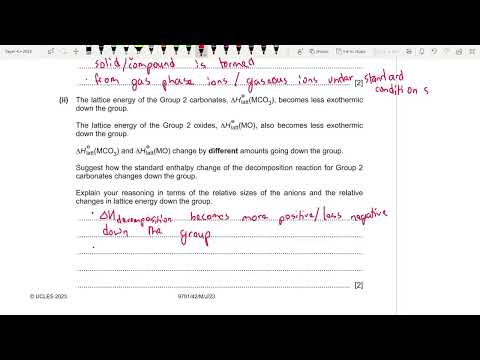
The oxide ion is smaller than the carbonate ion, so oxide lattice energy is more sensitive to the cation size.
ΔHdecomp becomes more positive (less negative) down the group.
The O2– ion is smaller than CO32–, so ΔHlatt of the oxides becomes less exothermic faster (changes more) than that of the carbonates. Any two of the three points score 1, all three score 2. [2]
(c)(i)
Combine the two half-equations. Multiply the sulfite one by 5 and the manganate one by 2, so 10 electrons cancel.
2MnO4– + 6H+ + 5SO32– → 2Mn2+ + 3H2O + 5SO42– [1]
(c)(ii)
Work from the titration to the whole 250 cm3 solution, then to the mass of K2SO3.
moles of MnO4– = 0.0250 × 22.40 ÷ 1000 = 5.6 × 10⁻⁴ mol
moles of SO32– in 25.0 cm3 = 5.6 × 10–4 × 5/2 = 1.4 × 10⁻³ mol
moles in 250 cm3 = 1.4 × 10⁻² mol
mass of K2SO3 = 1.4 × 10–2 × 158.3 = 2.2162 g (any two of these steps score 1, all four score 2) [2]
% purity = 2.2162 ÷ 3.40 × 100 = 65.2% [1]
(d)
S(α) has four bonded groups (S, O, O, O) and no lone pair.
The shape around S(α) is tetrahedral. [1]
Official mark scheme

 ▶ Whole paper
Video solution of the whole paper · by CAIE PAPERS SOLVED. Tap the picture to open it on YouTube.
Solutions follow the official Cambridge mark schemes; marks are shown in grey. Videos are from other YouTube channels. Paper codes read component / series / year: M/J = May/June, O/N = October/November. Past-paper questions © UCLES, reproduced for classroom practice.