Q53 · 9700/42/O/N/20 Q9
Worked solution from the Inheritance Theory (Paper 4) booklet, Part 3 of 3.

Worked solution
(a)
The question asks for differences between two pairs: structural and regulatory genes, and repressible and inducible enzymes. Give named examples. Write any nine of these twelve points.
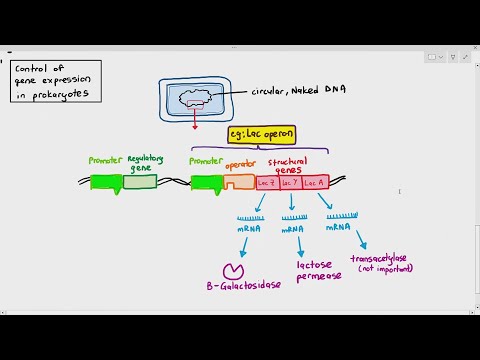
Structural genes code for structural or non-regulatory proteins, such as enzymes (or rRNA and tRNA). [1]
Named example of a structural gene: lacZ, lacY or lacA (coding for β-galactosidase, lactose permease or transacetylase). [1]
Enzymes and other proteins used in the cell are made from structural genes. (also credited)
Regulatory genes code for regulatory proteins that control other genes. [1]
Named example of a regulatory gene: lacI, which codes for the repressor protein (or genes for transcription factors). [1]
Regulatory genes switch other genes on or off, controlling gene expression and transcription. (also credited)
Repressible enzymes are generally produced continuously. [1]
Their synthesis can be stopped when a repressor protein binds to a specific site such as the promoter or operator. [1]
Named example: the enzymes for tryptophan synthesis. [1]
Inducible enzymes are made only when the substrate (inducer) is present. [1]
The inducer binds to the repressor or transcription factor, so transcription of the gene can happen. (also credited)
Named example: β-galactosidase (or lactose permease). [1]
(b)
Any six points score:
Transcription factors can be part of a protein complex. [1]
They bind to DNA at the promoter or an enhancer. [1]
This lets RNA polymerase bind to the promoter, so transcription begins and the gene is switched on (mRNA is made). [1]
If a transcription factor binds and blocks, no transcription takes place and the gene is switched off. [1]
They activate genes in the correct order, time, cells and amount, giving the correct pattern of development (for example homeobox / Hox genes). [1]
They allow responses to the environment or to hormones (for example genes switched on by light or high temperature), and they help regulate the cell cycle. [1]
Official mark scheme

 ▶ Topic lesson
A lesson on this topic · by OtterBioTutor. Tap the picture to open it on YouTube.
Solutions follow the official Cambridge mark schemes; marks are shown in grey. Videos are from other YouTube channels. Paper codes read component / series / year: M/J = May/June, O/N = October/November. Past-paper questions © UCLES, reproduced for classroom practice.