Q33 · 5090/22/O/N/24 Q5
Worked solution from the Relationships of organisms with one another and with the environment Theory (Paper 2) booklet, Part 5 of 5.

Worked solution
(a)
The question asks what a sustainable resource is.
Write: it is a resource that is produced as rapidly as it is removed (used or harvested). [1]
So it does not run out, and it is still there for future generations. [1]
(b)(i)
Look at the bars in Fig. 5.1 and read off the values. The quota is about 33 000 tonnes in 2012 and about 2 000 tonnes in 2020.
Description: the quota shows an overall decrease from 2012 to 2020 (it rises a little in 2014 and 2017). [1]
Quote data: it falls from about 33 000 tonnes in 2012 to about 2 000 tonnes in 2020. [1]
Explanations (any two of these): overfishing / too many fish were caught, so there are fewer fish left. [1]
The quota was set too high / was not sustainable, so it had to be cut. [1]
Other ideas that are credited: the quota was lowered the next year to compensate for fish caught in earlier years; fish were caught before they could breed; an increase in natural predators, disease or competition, or a decrease in prey, reduced the herring.
(b)(ii)
Choose two methods other than quotas. Name each one, then explain it.
Method 1: write education (teaching fishermen and the public about the need to protect fish stocks). [1]
Explanation: people learn why fish must be conserved, so they take fewer fish and choose sustainable fish. [1]
Method 2: write closed seasons (no fishing at the time when fish breed). [1]
Explanation: the fish can breed without being caught, so the numbers of young fish increase and the stock recovers. [1]
Other methods that are credited: protected areas, controlled net types / bigger mesh size (young fish escape), monitoring / enforcement (checks and fines).
(c)
Think about what each substance does: bile does not digest fat, but it makes lipase work better. Lipase digests lipids.
Bile emulsifies the oil: it breaks large oil droplets into small droplets, which increases the surface area for lipase (this applies to either experiment). [1]
Experiment 1: there is no lipase, so there is no digestion of the oil. [1]
So the pH stays at 8.0. [1]
Experiment 2: bile also gives the alkaline, optimum pH for lipase to work. Lipase digests / breaks down the lipid (oil) into fatty acids and glycerol. [1]
The fatty acids are acidic, so the pH falls below 8.0. [1]
There are more points than marks here: any five of the scoring points above earn the 5 marks.
Official mark scheme

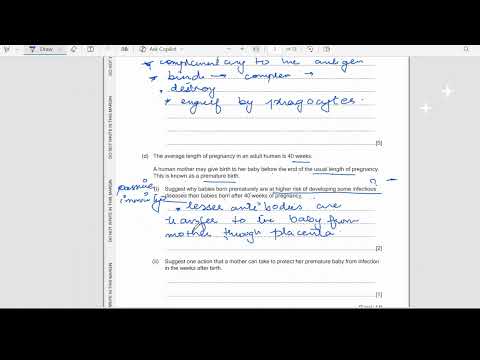 ▶ Whole paper
Video solution of the whole paper · by Learn with Miss Sehrish. Tap the picture to open it on YouTube.
Solutions follow the official Cambridge mark schemes; marks are shown in grey. Videos are from other YouTube channels. Paper codes read component / series / year: M/J = May/June, O/N = October/November. Past-paper questions © UCLES, reproduced for classroom practice.