Q11 · 5070/21/O/N/20 Q7
Worked solution from the Metals Theory (Paper 2) booklet, Part 4 of 4.

Worked solution
(a)(i)
Carbon can only take oxygen from metals lower than it in the series.
Write that aluminium is very high in the reactivity series (its ions accept electrons less readily than carbon). [1]
(a)(ii)
Aluminium oxide has a very high melting point. It dissolves in molten cryolite.
Write that cryolite dissolves the aluminium oxide. [1]
(a)(iii)
Each oxide ion loses 2 electrons, and 2 oxide ions make one O2 molecule.
Write 2O2− → O2 + 4e−. [1]
(b)(i)
Reduction means loss of oxygen.
Write that oxygen is removed from aluminium oxide (it loses oxygen). [1]
(b)(ii)
Use moles. Al2O3 → 2Al, so 1 mol of oxide gives 2 mol of aluminium.
Mr of Al2O3 = (2 × 27) + (3 × 16) = 102
Moles of Al2O3 = 25.5 ÷ 102 = 0.25 mol. [1]
Moles of Al = 2 × 0.25 = 0.5 mol
Mass of Al = 0.5 × 27 = 13.5 g. [1]
(c)
Think about the layers of ions in a metal.
Write that the metal has (positive) ions arranged in layers. [1]
Write that the layers slide over each other easily when hit or pushed. [1]
(d)
Energy is taken in to break bonds and given out when bonds form.
Write that bond breaking is endothermic and bond making is exothermic (heat is absorbed to break bonds and released on making bonds). [1]
Write that more energy is released than absorbed. [1]
Official mark scheme

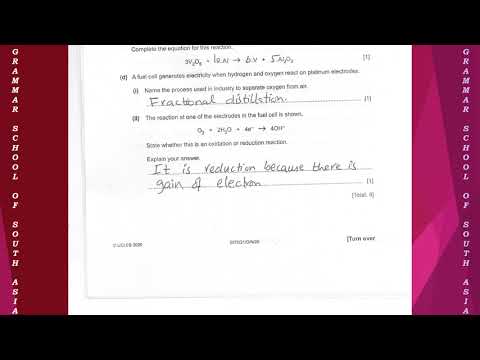 ▶ Whole paper
Video solution of the whole paper · by A Levels Academy Islamabad. Tap the picture to open it on YouTube.
Solutions follow the official Cambridge mark schemes; marks are shown in grey. Videos are from other YouTube channels. Paper codes read component / series / year: M/J = May/June, O/N = October/November. Past-paper questions © UCLES, reproduced for classroom practice.