Q49 · 9700/42/F/M/22 Q10
Worked solution from the Homeostasis Theory (Paper 4) booklet, Part 2 of 2.

Worked solution
(a)
Look at Fig. 10.1: A points to a small oval organelle in the cytoplasm, B points to the large central space, C points to the outer boundary.
A: chloroplast. [1]
B: vacuole. [1]
C: cell wall. [1]
(b)
The question asks for the role of abscisic acid (ABA) in closing stomata. Any four points score.
Abscisic acid binds to receptors on the cell surface membrane of the guard cell. [1]
Proton pumps are inhibited; Ca2+ channels open and Ca2+ acts as a second messenger. [1]
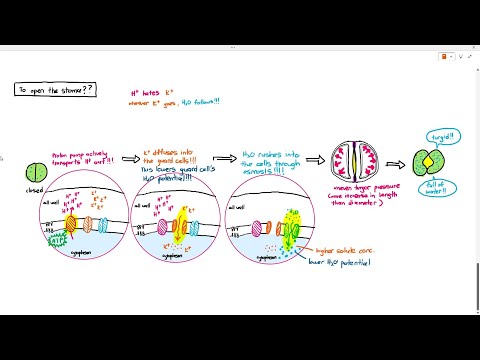
K+ diffuses out of the guard cell, so the water potential of the guard cell increases. [1]
Water leaves by osmosis, so the guard cell becomes flaccid and the stoma closes. [1]
Official mark scheme

 ▶ Topic lesson
A lesson on this topic · by OtterBioTutor. Tap the picture to open it on YouTube.
Solutions follow the official Cambridge mark schemes; marks are shown in grey. Videos are from other YouTube channels. Paper codes read component / series / year: M/J = May/June, O/N = October/November. Past-paper questions © UCLES, reproduced for classroom practice.