Q92 · 9700/13/O/N/22 Q36
Worked solution from the Transport in mammals MCQ booklet.

Worked solution
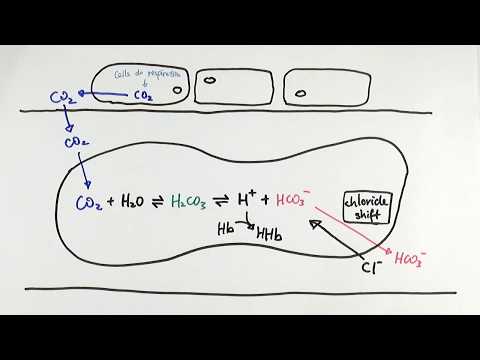
The question asks where most chloride ions would be in the red blood cells. This is the chloride shift.
In respiring tissues, carbon dioxide enters red blood cells and carbonic anhydrase turns it into HCO3– and H+. The HCO3– ions move out of the cell, and chloride ions move in to balance the charge.
So the most chloride ions are in the red blood cells where there is the most carbon dioxide and the lowest oxygen.
The high carbon dioxide curve is the lower curve. Of the points on it, B is at a low partial pressure of oxygen, as in respiring tissues. A is on the low carbon dioxide curve. C and D are at high oxygen where little CO2 is being picked up.
So the answer is B.
 ▶ Topic lesson
A lesson on this topic · by BioRach. Tap the picture to open it on YouTube.
Solutions follow the official Cambridge mark schemes. Videos are from other YouTube channels. Paper codes read component / series / year: M/J = May/June, O/N = October/November. Past-paper questions © UCLES, reproduced for classroom practice.