Q1 · 5070/21/O/N/20 Q2
Worked solution from the Organic chemistry Theory (Paper 2) booklet, Part 1 of 7.

Worked solution
(a)
Boiling point depends on how strong the forces are that must be broken. Look at the type of structure.
Write: carbon dioxide is a simple molecule and calcium carbide is ionic. [1]
Carbon dioxide has weak forces between molecules (weak intermolecular forces), so little energy is needed to boil it. [1]
Calcium carbide has strong attractive forces between its ions, so a lot of energy is needed. [1]
(b)
Unbalanced: CaC2 + H2O → C2H2 + Ca(OH)2
Ca(OH)2 has 2 O and 2 H; C2H2 has 2 H. So we need 2 H2O.
Write CaC2 + 2H2O → C2H2 + Ca(OH)2 [1]
(c)
Write: a compound that contains carbon and hydrogen only. [1]
(d)
The alkynes follow CnH2n−2. The first is n = 2, so the fifth is n = 6.
Write C6H10. [1]
(e)(i)
Write: addition (also accepted: reduction or hydrogenation). [1]
(e)(ii)
Adding one H2 to ethyne gives ethene. Adding two H2 gives ethane.
Write C2H4 (or C2H6). [1]
(f)
In addition polymerisation the C=C opens and each monomer joins to the next. The Cl and H atoms stay as side groups.
Draw a chain of six carbons. Each carbon has one Cl above it and one H below it (each unit has two carbons, because the monomer has two).
Show three repeat units (six backbone carbons with Cl and H on each) with extension bonds at both ends. [2]
Official mark scheme

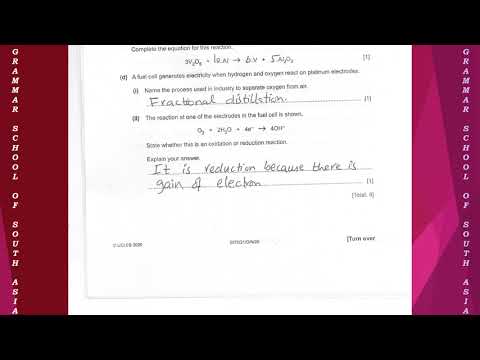 ▶ Whole paper
Video solution of the whole paper · by A Levels Academy Islamabad. Tap the picture to open it on YouTube.
Solutions follow the official Cambridge mark schemes; marks are shown in grey. Videos are from other YouTube channels. Paper codes read component / series / year: M/J = May/June, O/N = October/November. Past-paper questions © UCLES, reproduced for classroom practice.