Q4 · 9708/22/O/N/23 Q3
Worked solution from the Government microeconomic intervention Theory (Paper 2) booklet, Part 1 of 3.

Worked solution
(a)
Explain means: give each point and say why. Then consider the view in the question.
Write: a free good is not scarce, so it has zero opportunity cost and no price, because no factors of production are needed to produce it. [1]
Write: a public good has two features: non-excludability (people cannot be stopped from using it) and non-rivalry (one person using it does not stop others using it). [1]
Give an example of each: for example fresh air as a free good and street lighting as a public good. [1]
Explain that non-excludability leads to the free rider problem, because people can use the good without paying. [1]
Explain that non-rivalry also leads to the free rider problem, because extra users cost nothing more, so there is no reason to pay. [1]
So it is impossible or unrealistic to charge a price, the market would not supply it, and so the government must provide it. [1]
Consider the view: pure public goods can never be provided in a market economy unless they are directly funded by the government. Or say that some goods are quasi- or semi-public goods, where a price can be charged, so a market economy could provide them. Either point earns the mark. [1]
Finish with a justified conclusion that answers the view. [1]
(b)
Assess means: weigh both sides and reach a judgement. The answer must compare a market economy with a mixed economy.
Explain how private goods (including merit and demerit goods) are allocated through demand and supply, with the price system rationing them.
Explain imperfect information over merit and demerit goods: consumers do not know the true benefits or harm, so there is underconsumption of merit goods and overconsumption of demerit goods.
Explain that this means merit and demerit goods are allocated differently from other private goods, which the market can supply well through price.
In a market economy, nothing corrects this, so the market fails to operate efficiently and the consequences are serious.
In a mixed economy, the government can step in to correct these problems, so the consequences are smaller.
Compare both types of economy for merit and demerit goods against other private goods, so that the answer is not limited to Level 2.
This reaches the top level for knowledge, understanding and analysis: detailed, accurate analysis with relevant concepts fully developed and explained, and a well-organised answer. [8]
Evaluation, side one: merit and demerit goods need government intervention because of under and overconsumption, so a market economy fails to operate efficiently, and the consequences are more serious there.
Evaluation, side two: other private goods can be provided efficiently by the market without intervention, though allocation by price may mean low-income groups do not get the same access to some goods.
Conclusion: the consequences of imperfect information are more serious in a market economy, because only a mixed economy has a way to correct them, though the size of the problem depends on the good.
It reaches the top level for evaluation: a justified conclusion that addresses the question, with developed, reasoned comments. [4]
Official mark scheme

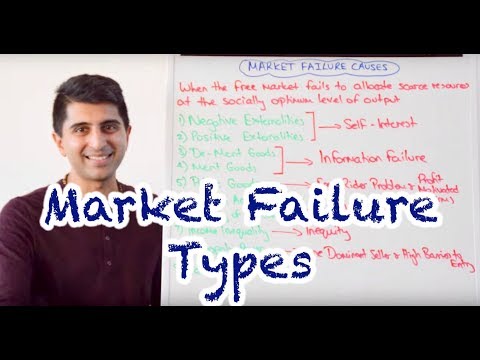 ▶ Topic lesson
A lesson on this topic · by EconplusDal. Tap the picture to open it on YouTube.
Solutions follow the official Cambridge mark schemes; marks are shown in grey. Videos are from other YouTube channels. Paper codes read component / series / year: M/J = May/June, O/N = October/November. Past-paper questions © UCLES, reproduced for classroom practice.