Q15 · 0620/23/M/J/22 Q5
Worked solution from the Atoms, elements and compounds MCQ booklet.

Worked solution
Particle P: atomic number 18, so 18 protons. No charge, so 18 electrons. Electron structure 2,8,8. Neutrons = 40 − 18 = 22. P is an argon atom.
Particle Q: atomic number 19, so 19 protons. A single positive charge means 18 electrons. Electron structure 2,8,8. Neutrons = 40 − 19 = 21. Q is a K+ ion.
Both have 8 electrons in their outer shell.
So the answer is D.
A is wrong because they have different atomic numbers, so they are different elements. B is wrong because P has no charge, so it is an atom. C is wrong because Q has 21 neutrons and P has 22, so Q has fewer.
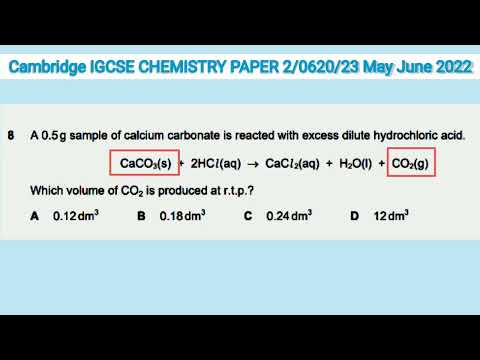 ▶ Whole paper
Video solution of the whole paper · by Learning Support. Tap the picture to open it on YouTube.
Solutions follow the official Cambridge mark schemes. Videos are from other YouTube channels. Paper codes read component / series / year: M/J = May/June, O/N = October/November. Past-paper questions © UCLES, reproduced for classroom practice.