Q41 · 9708/21/O/N/22 Q3
Worked solution from the Government macroeconomic intervention Theory (Paper 2) booklet, Part 4 of 4.

Worked solution
(a)
A PPC shows the maximum combinations of two goods an economy can make with all its resources fully used.
Write: a PPC is based on a two-product economy. [1]
It shows the range of combinations of two products that can be produced when existing resources are fully used. [1]
Decrease in quantity of labour: this reduces the productive potential of the economy. [1]
Diagram 1: label the axes with two different goods (each named), draw the PPC so that it touches both axes, and label it. [1]
Shift the PPC inwards (to the left), from PPC to PPC1, on both axes. [1]
Increase in quality of labour (better skills and training): this increases the productive potential of the economy. [1]
Diagram 2: draw the axes and the PPC again, touching both axes and labelled. [1]
Shift the PPC outwards (to the right), from PPC to PPC1. [1]
(b)
Discuss means: advantages, limitations, then a judgement.
Advantage: lower taxes can encourage people to become entrepreneurs. [1]
Advantage: more spending on education and training can improve the quality of enterprise, making entrepreneurs more innovative and willing to take risks. [1]
Advantage: deregulation reduces laws and makes setting up a business easier. [1]
Advantage: government financial support helps enterprises survive and stay in business. [1]
Limitation: the effects of supply-side policies can take a long time to show (for example training). [1]
Limitation: some entrepreneurs may become too dependent on government support and become inefficient. [1]
Limitation: the policies do not guarantee that all enterprises will be successful, and it is questionable whether enterprise can be taught. [1]
Limitation: a privatisation policy might reduce the quantity of the factor enterprise needed. [1]
Evaluation: judge how far they succeed, for example they help most where there are barriers to starting a firm, but do not guarantee success. [1]
Weigh the time lag against the benefits, and say it depends on the economy and on the policy chosen. [1]
Make a further reasoned comment, for example that the policies cannot be sure to succeed for every entrepreneur. [1]
Conclusion: write a justified judgement on whether supply-side policies will be successful. [1]
Official mark scheme

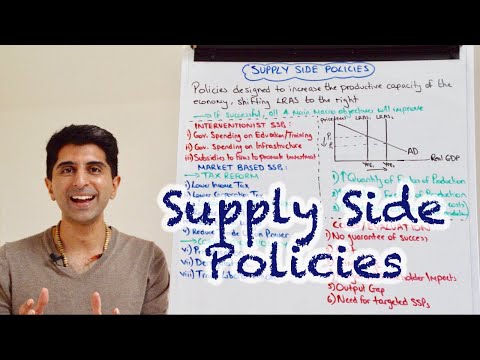 ▶ Topic lesson
A lesson on this topic · by EconplusDal. Tap the picture to open it on YouTube.
Solutions follow the official Cambridge mark schemes; marks are shown in grey. Videos are from other YouTube channels. Paper codes read component / series / year: M/J = May/June, O/N = October/November. Past-paper questions © UCLES, reproduced for classroom practice.