Q22 · 9708/21/O/N/22 Q1
Worked solution from the Government microeconomic intervention Theory (Paper 2) booklet, Part 2 of 3.

Worked solution
(a)
Write: resources are limited but wants are unlimited, so price rations the available goods among competing buyers. [1]
Write: if demand rises relative to supply, the price rises, which signals scarcity and gives firms an incentive to supply more. [1]
(b)
Write one reason: the government may want to reduce the demand for fuel. [1]
A higher price cuts the quantity demanded, especially if the PED for fuel is elastic. (Other accepted reasons: encourage producers to supply more, raise tax revenue from higher profits, or reallocate money saved on subsidies.) [1]
(c)
Explain: an effective minimum price is a price floor set above the equilibrium price. [1]
Farmers are guaranteed a higher price, which raises their incomes, but it causes excess supply (a surplus), so food may rot in warehouses. [1]
Diagram: draw price up the vertical axis and quantity along the horizontal axis. Draw a downward-sloping demand curve D and an upward-sloping supply curve S meeting at the equilibrium (P, Q). Label the axes and curves correctly. [1]
Draw a horizontal minimum price line above P. Mark the quantity supplied (higher than Q) and the quantity demanded (lower than Q), and show the gap between them as the surplus. [1]
(d)
Discuss means: say how government action might help the price mechanism, how it might not, then decide.
Might help: it stabilises the market, [1]
because the government buys stocks when there is excess supply and sells them when there is excess demand, reducing large price swings. [1]
Might not help: it can distort the market, because prices no longer reflect changes in demand and supply, [1]
which weakens the price mechanism's functions of rationing, signalling and transmitting preferences. [1]
Another point on the same side: with prices held steady, the price no longer signals scarcity or an incentive to change output. [1]
Conclusion: smoothing helps by reducing large swings, but it overrides the signals the price mechanism gives, so it helps only in part. [1]
(e)
Discuss means: give the advantages and disadvantages of maximum prices for controlling inflation, then decide.
Advantages: the price is lower than it would be without intervention, [1]
so the rate of inflation is lower, and it helps the poor afford necessities such as food, rents and transport (for example bread in Benin and rice in Haiti). [1]
Disadvantages: lower prices can stimulate demand-pull inflation, and create a shortage because of the excess demand, [1]
with hoarding, black markets charging high prices, and queuing or rationing. [1]
If the controls are not effective (for example not set below the equilibrium price), they will not control inflation. [1]
Conclusion: maximum prices do not always control inflation. They can lower prices for necessities but cause shortages and black markets, so they are not always effective. [1]
Official mark scheme

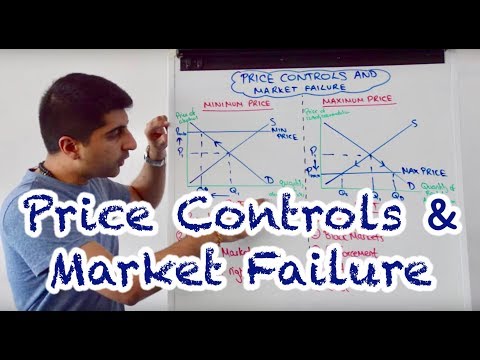 ▶ Topic lesson
A lesson on this topic · by EconplusDal. Tap the picture to open it on YouTube.
Solutions follow the official Cambridge mark schemes; marks are shown in grey. Videos are from other YouTube channels. Paper codes read component / series / year: M/J = May/June, O/N = October/November. Past-paper questions © UCLES, reproduced for classroom practice.