Q2 · 5090/21/O/N/21 Q6
Worked solution from the Enzymes Theory (Paper 2) booklet, Part 1 of 2.

Worked solution
(a)
The question asks you to explain the lock and key idea and to use a named enzyme. Use amylase and starch.
Write: the enzyme (amylase) has an active site. [1]
Write: the substrate (starch) has a shape that fits the active site, so the enzyme is specific to it. [1]
Write: the substrate fits into the active site and an enzyme-substrate complex forms. [1]
Write: the starch is broken down and a named product (maltose) is formed. [1]
Write: the enzyme is unchanged at the end of the reaction, so it can be used again. [1]
(b)
The question asks why all living things need proteins. Give uses with examples. Any five of these:
Write: proteins are needed for growth (new cells). [1]
Write: proteins are needed for repair of damaged tissues. [1]
Write: proteins make enzymes, which speed up reactions. [1]
Write: proteins make antibodies, which fight pathogens. [1]
Write: proteins make hormones, such as insulin, or muscle, or a named protein such as haemoglobin (carries oxygen) or fibrinogen (blood clotting). Only five marks can be scored in total. [1]
Also accepted: hair, nails and skin; carrier proteins in the cell membrane; energy when there is no carbohydrate or fat.
Official mark scheme

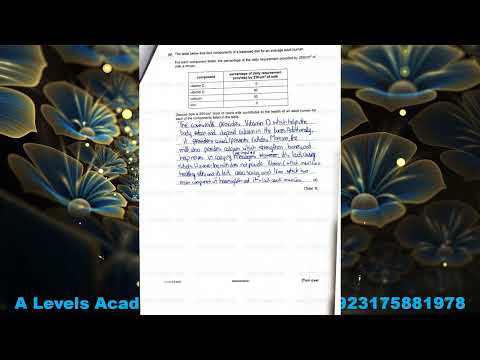 ▶ Whole paper
Video solution of the whole paper · by A Levels Academy Islamabad. Tap the picture to open it on YouTube.
Solutions follow the official Cambridge mark schemes; marks are shown in grey. Videos are from other YouTube channels. Paper codes read component / series / year: M/J = May/June, O/N = October/November. Past-paper questions © UCLES, reproduced for classroom practice.