Q26 · 9708/42/O/N/21 Q6
Worked solution from the The macroeconomy Theory (Paper 4) booklet, Part 3 of 4.

Worked solution
(a)
Explain means: say what each kind of unemployment is and make the difference between them clear.
Write: frictional unemployment is temporary unemployment of workers who have left their job, or been dismissed, and are searching for another job.
Write: real wage (classical) unemployment happens when the wage is held above the equilibrium wage, for example by trade union power or minimum wage legislation.
Explain the real wage case: at the higher wage firms want to hire fewer workers, while more people want to work, so there is a surplus of labour. (Draw a labour market diagram: wage up, quantity of labour along, demand and supply, equilibrium wage We, a higher wage W1 with the gap between the two quantities shown as unemployment.)
Make the difference clear: frictional unemployment is short term and comes from the time spent searching, with jobs available. Real wage unemployment comes from a wage that is too high and lasts as long as the wage stays above equilibrium.
This reaches Level 4: both forms of unemployment are explained and the difference between them is made clear. [12]
(b)
Evaluate means: explain each policy and judge how well it works.
Write: structural unemployment is unemployment caused by a mismatch between workers' skills and the jobs available, usually because industries decline or change.
Policy 1, education and training: gives workers new skills, so they can move into growing industries. Evaluate: it is slow and costly, and not all workers retrain successfully.
Policy 2, lower corporation tax: firms keep more profit, so they grow and employ more workers. Evaluate: it takes time to work and firms may not hire the structurally unemployed.
Policy 3, reducing trade union power, or subsidies for housing costs to help workers move, so labour is more flexible and easier to move to where jobs are. Evaluate: moving costs and family ties can still stop workers moving. An increased minimum wage can also act as an incentive to work, but may reduce the number of jobs.
Fiscal aspects such as tariffs to protect declining industries can also be accepted. Evaluate: they may raise prices and cause retaliation.
Conclude: supply-side policies address the cause of structural unemployment, but they work slowly, so a mix of policies is best.
This reaches Level 4: it evaluates three policies available to a government to reduce structural unemployment. [13]
Official mark scheme

 ▶ Topic lesson
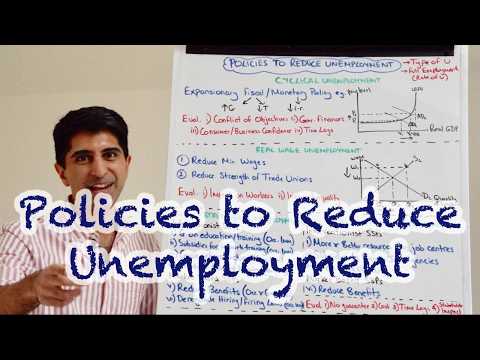
A lesson on this topic · by EconplusDal. Tap the picture to open it on YouTube.
Solutions follow the official Cambridge mark schemes; marks are shown in grey. Videos are from other YouTube channels. Paper codes read component / series / year: M/J = May/June, O/N = October/November. Past-paper questions © UCLES, reproduced for classroom practice.